Ian McEwan’s ‘Atonement’ Novel Analysis
Ian McEwan’s Atonement is a novel that demands careful consideration of narrative construction and the ethical implications of storytelling. This analysis will dissect its layered structure, thematic core, and the deliberate ways it challenges reader perception, offering a grounded approach to understanding its enduring impact.
Who This Is For
- Readers interested in the profound impact of a single misinterpretation and its lifelong consequences.
- Those who appreciate narratives that explore the subjective nature of truth and the power of storytelling to shape reality.
What to Check First
- Briony’s Perspective: The novel hinges on young Briony Tallis’s vivid imagination and her pivotal misreading of events, setting in motion the central conflict.
- Narrative Layers: McEwan deliberately employs multiple narrative voices and temporal shifts. Understanding these distinctions is key to deconstructing the story.
- Thematic Interplay: Guilt, class, memory, and the ethics of narrative are intricately woven. Identify how these themes evolve across the novel’s distinct parts.
- Metafictional Underpinnings: The later sections, particularly the epilogue, directly address the act of writing and its role in constructing reality and offering absolution.
Step-by-Step Plan for Understanding Atonement by Ian McEwan
1. Deconstruct Part One: The Tallis Estate and the Lie.
- Action: Read Part One, meticulously noting Briony’s observations, her fascination with adult dramas, and the charged atmosphere between Robbie Turner and Cecilia Tallis. Pay attention to her literary inclinations and how she frames events.
- What to look for: The specific details Briony notices and misinterprets, the sensory overload of the hot summer day, and the nascent tensions rooted in class and unspoken desire.
- Mistake to avoid: Dismissing Briony’s actions as purely childish malice. Her misinterpretation stems from a complex blend of youthful imagination, a desire for narrative order, and social observation.
2. Process Part Two: The Brutality of War.
- Action: Engage with Part Two, focusing on Robbie Turner’s harrowing experiences during the Dunkirk evacuation and Cecilia’s wartime reality. Observe the stark shift in tone and narrative style.
- What to look for: The visceral depiction of war as a direct consequence of the events in Part One, and McEwan’s use of a more objective, almost journalistic prose to convey the harsh realities faced by the characters.
- Mistake to avoid: Underestimating the thematic weight of this section. It grounds the narrative in tangible suffering, demonstrating the irreversible damage caused by the initial misjudgment.
3. Analyze Part Three: Briony’s Reckoning.
- Action: Read Part Three, observing Briony’s maturation as a nurse and her internal struggle to reconcile her past actions with her present.
- What to look for: Briony’s evolving consciousness of her culpability, her attempts to “atone” through her writing, and the subtle ways her narrative voice begins to reflect a deeper understanding of consequence.
- Mistake to avoid: Accepting Briony’s retrospective account as definitive truth. The novel consistently signals that memory and narrative are fluid and subjective.
To fully grasp the complexities of Ian McEwan’s ‘Atonement,’ having a copy of the novel is essential. It allows for easy reference to specific passages and a deeper immersion into Briony’s world.
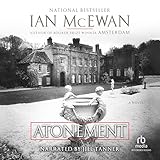
- Audible Audiobook
- Ian McEwan (Author) - Jill Tanner (Narrator)
- English (Publication Language)
- 08/15/2003 (Publication Date) - Recorded Books (Publisher)
4. Confront the Epilogue: The Metafictional Revelation.
- Action: Read the Epilogue, recognizing its explicit authorial commentary on the nature of storytelling and the pursuit of atonement.
- What to look for: The direct discussion of fictional constructs, the author’s power to shape empathy and deliver a form of narrative justice, and the ultimate question of whether Briony’s final narrative constitutes genuine atonement or a sophisticated act of self-preservation.
- Mistake to avoid: Viewing the Epilogue as a simple resolution. It is McEwan’s most direct engagement with the ethical complexities and limitations of fiction.
5. Synthesize Thematic Interconnections.
- Action: Review your observations regarding guilt, memory, class, the destructive power of misinterpretation, and the ethics of narrative across all sections.
- What to look for: The intricate ways these themes interlock and inform each other, culminating in the novel’s complex commentary on storytelling and absolution.
- Mistake to avoid: Focusing on a single theme in isolation. The novel’s power lies in the layered and interwoven nature of its thematic concerns.
Expert Tips for Analyzing Atonement by Ian McEwan
- Tip 1: Chart Narrative Perspective Shifts.
- Action: Create a simple table noting the primary narrator and perspective for each major section of the novel, highlighting any significant shifts in tone or implied bias.
- Common Mistake to Avoid: Assuming any single narrative voice represents objective reality. McEwan uses distinct perspectives to explore subjective experience and the construction of truth.
- Tip 2: Trace Symbolism Evolution.
- Action: Maintain a running list of recurring motifs and symbols (e.g., the fountain, the letter, the heat) and document how their meaning or emotional resonance changes as the narrative progresses.
- Common Mistake to Avoid: Treating symbols as static. Their significance often evolves in direct correlation with Briony’s understanding and the narrative’s development.
- Tip 3: Embrace Narrative Ambiguity.
- Action: Actively consider the questions McEwan deliberately leaves unanswered and the moments where information is withheld or presented unclearly, rather than seeking definitive resolutions for every plot point.
- Common Mistake to Avoid: Demanding absolute certainty from the text. The novel’s strength lies in its exploration of uncertainty and the reader’s active role in interpretation.
Common Myths About Atonement by Ian McEwan
- Myth: Atonement is primarily a tragic romance.
- Why it matters: This common framing, while understandable due to the central relationship between Robbie and Cecilia, tends to overshadow the novel’s more profound critiques of narrative responsibility and the subjective nature of truth. The love story is a powerful catalyst, but the core of the novel is about the devastating consequences of a singular misinterpretation and the subsequent lifelong reckoning.
- Fix: Recognize the romance as a vital component, but understand that the narrative’s true engine is Briony’s lie and her lifelong struggle with its repercussions, making the novel as much about guilt and storytelling as it is about love.
- Myth: Briony’s final narrative offers a straightforward act of redemption.
- Why it matters: This interpretation simplifies McEwan’s nuanced commentary on the ethics of fiction. The novel questions whether a meticulously crafted narrative can truly achieve atonement, or if it represents a sophisticated form of self-deception—a way for Briony to control the narrative of her own guilt.
- Fix: Approach the Epilogue with critical distance, understanding that Briony’s final version of events is her attempt to achieve narrative justice, but the novel deliberately leaves open the question of whether this constitutes true atonement or merely a writer’s manipulation.
- Myth: The novel is solely about the unreliability of a child’s perspective.
- Why it matters: While Briony’s childhood misinterpretation is the inciting incident, the novel’s scope extends far beyond this singular event. It explores how memory itself is constructed and reconstructed over time, and how adult narratives can be as self-serving and unreliable as a child’s.
- Fix: Consider how all characters’ perspectives, including Briony’s adult self and the implied authorial voice, are subject to bias and the passage of time. This makes the novel a broader statement on the fluidity of memory and truth.
Literary Context and Thematic Significance
Atonement by Ian McEwan stands as a significant work within contemporary literature, lauded for its intricate narrative architecture and its profound exploration of enduring human themes. The novel’s structure, moving from the concentrated intensity of a single summer day to the vast, stark realities of war and culminating in a self-reflexive meta-fictional conclusion, deliberately mirrors the fragmented and often unreliable nature of memory itself. McEwan employs this structural complexity not merely for stylistic effect, but to interrogate how individuals construct their understanding of past events and how fiction can both distort and attempt to rectify perceived wrongs. The novel’s deep dive into guilt, particularly the enduring burden carried by Briony Tallis, resonates powerfully by illustrating the psychological weight of past actions and the complex, frequently elusive, path toward reconciliation. Its meta-fictional elements, especially evident in the epilogue, compel critical reflection on the author’s role in shaping narratives and the very definition of “truth” within the literary sphere.
BLOCKQUOTE_0
This quote underscores the novel’s central preoccupation: the personal narrative as a vehicle for both profound guilt and attempted absolution. McEwan challenges the reader to question whether a meticulously crafted narrative can truly serve as atonement, or if it represents a sophisticated form of self-deception, a means for Briony to control the narrative of her own culpability.
Comparative Analysis of Narrative and Theme
| Feature | <em>Atonement by Ian McEwan</em> | <em>The Remains of the Day</em> (Kazuo Ishiguro) | <em>The Goldfinch</em> (Donna Tartt) |
|---|---|---|---|
| <strong>Primary Focus</strong> | Guilt, narrative reliability, consequences of a single act, the ethics of storytelling. | Duty, repressed emotion, missed opportunities, unreliable memory, social class and servitude. | Trauma, art, obsession, the search for meaning in a chaotic world, the impact of loss and addiction. |
| **Narrative Structure |
Decision Rules
- If reliability is your top priority for Atonement by Ian McEwan, choose the option with the strongest long-term track record and support.
- If value matters most, compare total ownership cost instead of headline price alone.
- If your use case is specific, prioritize fit-for-purpose features over generic ‘best overall’ claims.