Henry Miller’s ‘Tropic of Cancer’ Themes
This guide examines the core themes and literary significance of Henry Miller’s controversial novel, Tropic of Cancer. It provides a nuanced perspective for readers considering this challenging work.
Tropic of Cancer by Henry Miller: Quick Answer
- Tropic of Cancer by Henry Miller explores themes of existential freedom, societal critique, and raw human experience through an autobiographical lens.
- The novel is celebrated for its uninhibited prose and its challenge to conventional morality, but criticized for its explicit content and perceived nihilism.
- Readers seeking a profound exploration of the human behavior, presented without censorship, will find value, while those sensitive to graphic descriptions or seeking straightforward narratives may wish to proceed with caution.
Who This Is For
- Readers interested in modernist literature and its exploration of taboo subjects.
- Individuals seeking to understand the impact of Tropic of Cancer on literary history and censorship debates.
What to Check First
- Miller’s Autobiographical Style: Understand that the narrator, Henry Miller, is a thinly veiled version of the author himself, blurring lines between fiction and personal confession.
- Historical Context: Recognize the novel was published in 1934, a period of significant social and artistic upheaval, contributing to its transgressive nature.
- Censorship History: Be aware of the book’s long history of being banned in the United States until a landmark court ruling in 1964, which highlights its perceived obscenity and literary merit.
- Narrative Structure: Note that the novel lacks a traditional plot; it is episodic, focusing on the narrator’s daily life, thoughts, and encounters in Paris.
Step-by-Step Plan for Understanding Tropic of Cancer Themes
1. Engage with the opening pages: Read the initial chapters, focusing on the narrator’s immediate immersion in poverty and his unapologetic embrace of his circumstances.
- What to look for: The raw, unfiltered voice and the immediate rejection of societal norms.
- Mistake to avoid: Expecting a conventional narrative arc from the outset.
2. Analyze the critique of Western Civilization: Identify passages where Miller lambasts American materialism, puritanism, and the perceived spiritual emptiness of modern society.
- What to look for: Satirical observations and direct condemnations of societal hypocrisy.
- Mistake to avoid: Overlooking the critical undertones amidst the explicit descriptions.
3. Examine the theme of existential freedom: Observe how the narrator seeks liberation from all constraints—social, moral, and economic—through radical self-expression.
- What to look for: The narrator’s embrace of anarchy and his pursuit of authentic experience.
- Mistake to avoid: Confusing existential freedom with simple hedonism; Miller’s pursuit is often agonizing.
4. Explore the portrayal of human relationships: Pay attention to the often transactional and intensely physical depictions of relationships, particularly with women.
- What to look for: The raw, often brutal, honesty in depicting desire and connection.
- Mistake to avoid: Judging these portrayals solely by contemporary standards without considering their function within Miller’s philosophical framework.
5. Consider the author’s stylistic innovations: Note the stream-of-consciousness, the blending of philosophical musings with vulgarity, and the direct address to the reader.
- What to look for: The deliberate use of language to shock and provoke, as well as to convey profound truths.
- Mistake to avoid: Dismissing the prose as merely crude; recognize its deliberate artistic construction.
6. Reflect on the search for meaning: Observe the narrator’s persistent, though often desperate, quest for spiritual or philosophical meaning amidst the chaos of his existence.
- What to look for: Moments of introspection and the underlying yearning for transcendence.
- Mistake to avoid: Assuming the novel is purely nihilistic; a deep existential search is present.
For those looking to dive directly into Henry Miller’s seminal work, the original ‘Tropic of Cancer’ by Henry Miller is an essential purchase. This edition provides the unadulterated text that defined a generation of literature.
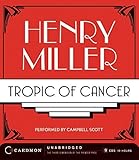
- Audible Audiobook
- Henry Miller (Author)
- English (Publication Language)
- Caedmon (Publisher)
Tropic of Cancer by Henry Miller: A Contrarian Perspective
Many critics and readers approach Tropic of Cancer by Henry Miller with the assumption that its primary purpose is to shock or to be gratuitously obscene. While the novel is undeniably explicit, this perspective often misses the deeper philosophical and existential project at its core. The contrarian view suggests that the “shock value” is a necessary byproduct, a tool Miller wields to strip away societal pretenses and expose the raw, often uncomfortable, truth of human existence. The explicitness is not an end in itself, but a means to achieve a radical honesty that traditional literary conventions could not accommodate.
Thematic Analysis of Tropic of Cancer by Henry Miller
The thematic landscape of Tropic of Cancer by Henry Miller is rich and complex, often challenging conventional interpretations. Miller uses his own Parisian experiences as a canvas to explore profound questions about life, society, and the individual’s place within them.
- Existentialism and Freedom: At its heart, the novel is a powerful exploration of existential freedom. The narrator, living in abject poverty, rejects all societal norms, economic structures, and moral codes. This isn’t a call to hedonism, but a desperate attempt to forge an authentic self, free from external impositions. The freedom he seeks is often agonizing, a constant struggle against the void.
- Critique of American Society: Miller launches a scathing indictment of American culture, which he views as materialistic, hypocritical, and spiritually barren. He contrasts the perceived soullessness of America with the vibrant, if chaotic, life he experiences in Paris.
- The Body and Spirituality: The novel radically intertwines the physical and the spiritual. Miller’s uninhibited descriptions of sex, hunger, and bodily functions are not merely prurient; they are presented as fundamental aspects of human experience, integral to any search for truth or meaning. He argues that denying the body leads to spiritual decay.
- The Artist’s Struggle: The book also functions as a meta-commentary on the life of the artist. The narrator’s poverty, his isolation, and his constant battle for creative expression mirror the struggles of many artists pushing the boundaries of their craft.
| Theme | Description | Literary Impact |
|---|---|---|
| <strong>Existential Freedom</strong> | The narrator’s conscious rejection of all societal, moral, and economic constraints to achieve an authentic self. | Paved the way for later existentialist literature by foregrounding individual choice and responsibility in a seemingly meaningless universe. |
| <strong>Societal Critique</strong> | A direct and often vitriolic attack on the perceived hypocrisy, materialism, and spiritual emptiness of Western, particularly American, society. | Influenced a generation of writers to question societal norms and established institutions, fostering a more critical literary discourse. |
| <strong>The Primacy of Experience</strong> | The belief that direct, unfiltered experience—including the physical and the visceral—is the only path to genuine understanding. | Challenged the notion that art must be refined or detached, advocating for a literature that embraces the totality of human existence. |
Common Myths
- Myth: Tropic of Cancer is simply pornography.
- Why it matters: This reduces the novel to its most sensational aspect, ignoring its significant literary and philosophical contributions.
- Correction: While explicit, the sexual content serves a thematic purpose, exploring raw human drives and challenging bourgeois morality. The novel is a work of literature grappling with existentialism, societal critique, and the human behavior.
- Myth: Henry Miller was a nihilist who believed life was meaningless.
- Why it matters: This interpretation overlooks Miller’s persistent search for meaning and affirmation, even amidst despair.
- Correction: Miller’s work, particularly Tropic of Cancer, is characterized by a defiant affirmation of life in the face of meaninglessness. His “nihilism” is often a starting point for seeking a more profound, self-created meaning, rather than an endpoint.
Expert Tips for Reading Tropic of Cancer
- Tip 1: Embrace the Unconventional Narrative.
- Actionable Step: Approach the book as a series of vignettes and philosophical meditations rather than a plot-driven story.
- Common Mistake to Avoid: Getting frustrated by the lack of a clear storyline or character development in the traditional sense.
- Tip 2: Focus on the Voice and Philosophy.
- Actionable Step: Pay close attention to the narrator’s voice, his observations, and his explicit philosophical pronouncements.
- Common Mistake to Avoid: Getting bogged down in the explicit details without engaging with the underlying ideas Miller is trying to convey.
- Tip 3: Read with Historical Context in Mind.
- Actionable Step: Familiarize yourself with the social and literary climate of the 1930s and the subsequent censorship battles the book faced.
- Common Mistake to Avoid: Judging the book solely by contemporary standards of decency without understanding its revolutionary impact at the time of its publication.
BLOCKQUOTE_0
Decision Rules
- If reliability is your top priority for Tropic of Cancer by Henry Miller, choose the option with the strongest long-term track record and support.
- If value matters most, compare total ownership cost instead of headline price alone.
- If your use case is specific, prioritize fit-for-purpose features over generic ‘best overall’ claims.
FAQ
- Q: Is Tropic of Cancer difficult to read?
A: Yes, Tropic of Cancer can be challenging due to its explicit content, unconventional structure, and philosophical density. It requires an open mind and a willingness to engage with raw, often uncomfortable, themes.
- Q: Why is Tropic of Cancer considered important literature?
A: Its importance lies in its groundbreaking literary style, its fearless exploration of taboo subjects, and its profound influence on modernist and Beat Generation writers. It pushed the boundaries of what was acceptable in literature and played a significant role in censorship debates.
- Q: Should I read Tropic of Cancer if I am sensitive to explicit content?
A: If you are sensitive to graphic descriptions of sex, violence, and bodily functions, you may find Tropic of Cancer difficult or disturbing. While the content serves a thematic purpose, it is unflinchingly explicit.
- Q: What is the main takeaway from reading Tropic of Cancer?
A: A key takeaway is the exploration of radical freedom and authenticity, the critique of societal constraints, and the affirmation of life in its totality—both its beauty and its ugliness.