Heinrich Heine’s The Harz Journey
This collection offers a potent distillation of Heinrich Heine’s sharp intellect and critical eye, primarily through his seminal travelogue, The Harz Journey, and a selection of his incisive prose. It is intended for readers who appreciate literary craftsmanship, historical context, and a nuanced, often ironic, engagement with art, culture, and society.
The Harz Journey And Selected Prose by Heinrich Heine: Who This Is For
- Discerning readers of 19th-century literature: Those interested in the intellectual currents of post-Romantic Germany and Heine’s unique contribution to literary criticism and social commentary will find this essential.
- Individuals who value sharp wit and skepticism: Readers who enjoy sophisticated irony, a critical dismantling of prevailing ideas, and prose that challenges assumptions will be well-served.
What to Check First
- Translator’s reputation and approach: The effectiveness of Heine’s nuanced prose hinges on the translator’s skill. Researching the translator’s previous work and any stated editorial principles can offer insight into the rendition of Heine’s voice and irony.
- Publication date and original context of each piece: Understanding when each essay or fragment was written and for what audience is crucial for deciphering Heine’s specific critiques, allusions, and the historical debates he engaged with.
- The breadth of the “Selected Prose”: Beyond the central Harz Journey, examine the range of other included writings to assess their thematic coherence and how they collectively build Heine’s intellectual portrait.
- Heine’s historical and biographical position: A basic awareness of Heine’s status as a German-Jewish intellectual navigating a complex political and cultural landscape in the early 19th century is vital for grasping the depth and often subversive nature of his commentary.
Unpacking The Harz Journey And Selected Prose by Heinrich Heine
Heinrich Heine’s The Harz Journey, first published in 1826, is far more than a simple account of a sojourn through the German mountains. It functions as a sophisticated literary device, a framework through which Heine dissects the prevailing Romantic sensibilities of his era, critiques German society, and probes the nature of artistic representation. His prose is characterized by an acute observational faculty, a deep well of intellectualism, and a pervasive, often disarming, irony that consistently questions established norms and perspectives.
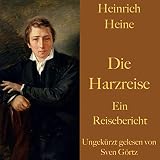
- Audible Audiobook
- Heinrich Heine (Author) - Sven Görtz (Narrator)
- German (Publication Language)
- 09/17/2019 (Publication Date) - Bäng Management & Verlags GmbH & Co. KG (Publisher)
The accompanying “Selected Prose” typically gathers essays and fragments that further amplify Heine’s critical stance. These pieces often elaborate on themes introduced in The Harz Journey, such as the inherent tension between idealistic aspirations and material reality, the evolving role of the artist, and the sociopolitical climate of early 19th-century Germany. The collection’s significant value lies in its capacity to convey complex ideas with both intellectual rigor and an engaging, often provocative, readability.
Thematic Resonance in The Harz Journey And Selected Prose by Heinrich Heine
Heine’s approach in The Harz Journey And Selected Prose by Heinrich Heine deliberately challenges and often subverts the tenets of Romanticism. While Romanticism typically celebrated nature, intense emotion, and the sublime, Heine injects a pragmatic, often skeptical, perspective. He describes the landscape, but his primary focus is on the dissection of human behavior, cultural narratives, and the societal constructs that shape perception. This leads to sharp social commentary, wherein he critiques burgeoning nationalism, the complacency of the bourgeoisie, and pretension within artistic circles.
The prose itself is a testament to Heine’s stylistic mastery, marked by its dynamic and multifaceted nature. He possesses an exceptional ability to shift seamlessly between lyrical descriptions and biting satire, often within the confines of a single paragraph. This stylistic versatility ensures that the reader is not a passive recipient of observations but is actively drawn into a critical dialogue with the text. The thematic consistency found across the selected prose pieces reinforces Heine’s core preoccupations: the complexities of identity, the pervasive illusions perpetuated by artistic and political movements, and the pursuit of an authentic experience in a world increasingly perceived as artificial.
Reading Context and Audience Fit
To fully appreciate The Harz Journey And Selected Prose by Heinrich Heine, a foundational understanding of the German literary and intellectual milieu of the early 19th century is highly beneficial. Familiarity with the Romantic movement, its prominent figures, and its underlying philosophical frameworks will significantly enhance a reader’s ability to grasp Heine’s specific critiques and allusions. Without this contextual grounding, some of his more subtle ironies and precise targets may remain elusive.
This collection is most appropriately suited for readers who possess an intellectual curiosity and are not dissuaded by a critical, even contrarian, voice. Those who seek straightforward, romanticized descriptions of nature might find Heine’s approach diverges from their expectations. However, for readers interested in literature that actively questions norms, engages critically with societal issues, and employs sophisticated wit, this work offers substantial intellectual rewards.
BLOCKQUOTE_0
This representative sentiment, encapsulating Heine’s critique of perceived German intellectual and cultural stagnation, underscores his propensity for using vivid imagery to expose what he viewed as national shortcomings.
Step-by-Step Reading Plan
1. Initiate with The Harz Journey: Begin with the central travelogue to establish Heine’s distinctive narrative voice and his initial thematic concerns.
- Action: Read the opening chapters of The Harz Journey.
- What to look for: Heine’s initial descriptions of the landscape and his early satirical observations of fellow travelers or local customs.
- Mistake to avoid: Underestimating the descriptive passages; they often contain subtle critiques embedded within the scenery.
2. Identify Recurring Motifs: As you progress, actively note any recurring themes or symbolic images, such as the contrast between superficial appearance and underlying reality, or the critique of artistic conventions.
- Action: Maintain a running list of recurring ideas or symbols encountered.
- What to look for: References to illusions, masks, or the performative aspect of emotion in social interactions.
- Mistake to avoid: Focusing solely on the narrative progression without recognizing the underlying thematic patterns.
3. Engage with the “Selected Prose”: Transition to the other essays, specifically seeking how they expand upon or reinforce the themes introduced in The Harz Journey.
- Action: Read one of the shorter prose pieces included in the collection.
- What to look for: Explicit or implicit connections to the critiques of Romanticism or German society presented in the travelogue.
- Mistake to avoid: Treating the prose pieces as disparate entities without considering their relationship to The Harz Journey.
4. Analyze Heine’s Tone: Pay close attention to Heine’s strategic use of irony, humor, and sarcasm.
- Action: Re-read a passage where the author’s tone appears particularly sharp or witty.
- What to look for: Juxtaposition of elevated language with mundane observations, or direct address to the reader with an implied knowing commentary.
- Mistake to avoid: Accepting all statements at face value without considering the author’s ironic intent or critical distance.
5. Consider Counter-Arguments: Heine frequently presents a dissenting viewpoint. Attempt to articulate precisely what conventional belief or artistic trend he is arguing against and why.
- Action: Identify a statement where Heine seems to be challenging a widely held belief or artistic convention.
- What to look for: The implied conventional wisdom or artistic trend that Heine is actively subverting.
- Mistake to avoid: Simply agreeing with Heine’s pronouncements without understanding the intellectual context he is reacting to.
6. Reflect on Enduring Relevance: Consider how Heine’s observations about society, art, and human nature continue to resonate in contemporary times.
- Action: Select one of Heine’s critiques that appears particularly timely.
- What to look for: Modern parallels to the societal issues or artistic trends he discusses in his work.
- Mistake to avoid: Viewing the work solely as a historical artifact, rather than as a piece with ongoing relevance to current discourse.
Common Myths and Counter-Arguments
- Myth: The Harz Journey is a straightforward, romantic depiction of the German countryside.
- Why it matters: This mischaracterizes Heine’s primary intention, which is critical and analytical rather than purely appreciative.
- Correction: Heine employs the landscape of the Harz Mountains as a backdrop for social and cultural commentary. He uses irony to critique the very Romantic idealization of nature, focusing on human perception and societal constructs as much as the natural world itself.
- Myth: Heine was simply a cynic with no genuine appreciation for art or beauty.
- Why it matters: This overlooks the complexity of his thought and the deep engagement he demonstrates with artistic and philosophical ideas, even as he critiques them.
- Correction: Heine’s skepticism serves as a tool for intellectual honesty. He engages deeply with Romanticism and other artistic movements, but he does so from a position of critical distance, prioritizing authenticity and clarity over unexamined sentiment. His critiques often stem from a profound understanding and a desire for more honest expression.
- Myth: The “Selected Prose” pieces are of secondary importance and can be omitted for a quicker reading.
- Why it matters: These essays frequently provide crucial context and significantly expand upon the themes and arguments presented in The Harz Journey.
- Correction: The selected prose offers a broader perspective on Heine’s critical philosophy, reinforcing his engagement with issues of art, politics, and identity. Skipping these pieces results in an incomplete understanding of his comprehensive literary project.
Expert Tips for Engaging with Heine
- Tip: Actively identify the targets of Heine’s satire.
- Action: When reading a passage that seems critical or humorous, pause to consider who or what Heine is implicitly mocking. Is it a specific literary trend, a social group, or a philosophical idea?
- Mistake to avoid: Assuming Heine’s wit is purely for entertainment; his satire is a vehicle for serious critique.
*
Quick Comparison
| Option | Best for | Pros | Watch out |
|---|---|---|---|
| The Harz Journey And Selected Prose by Heinrich Heine Who This Is For | General use | Discerning readers of 19th-century literature: Those interested in the intell… | Mistake to avoid: Underestimating the descriptive passages; they often contai… |
| What to Check First | General use | Individuals who value sharp wit and skepticism: Readers who enjoy sophisticat… | Mistake to avoid: Focusing solely on the narrative progression without recogn… |
| Thematic Resonance in The Harz Journey And Selected Prose by Heinrich Heine | General use | Translator’s reputation and approach: The effectiveness of Heine’s nuanced pr… | Mistake to avoid: Treating the prose pieces as disparate entities without con… |
| Reading Context and Audience Fit | General use | Publication date and original context of each piece: Understanding when each… | Mistake to avoid: Accepting all statements at face value without considering… |
Decision Rules
- If reliability is your top priority for The Harz Journey And Selected Prose by Heinrich Heine, choose the option with the strongest long-term track record and support.
- If value matters most, compare total ownership cost instead of headline price alone.
- If your use case is specific, prioritize fit-for-purpose features over generic ‘best overall’ claims.