H. G. Wells’ The Island of Doctor Moreau: Science and Ethics
Quick Answer
- The Island of Doctor Moreau by H. G. Wells is a cautionary tale examining the ethical limits of scientific ambition.
- The novel questions the definition of humanity through its depiction of surgical animal experimentation.
- Its enduring relevance lies in its prescient exploration of genetic manipulation and scientific responsibility.
Who This Is For
- Readers interested in classic science fiction that explores profound ethical questions.
- Individuals examining the consequences of scientific advancement without moral restraint.
What to Check First
- Historical Context: Published in 1896, the novel reflects anxieties about rapid scientific progress and early debates on vivisection.
- Author’s Concerns: H. G. Wells frequently used his fiction to explore societal issues and warn against potential abuses of science and technology.
- Central Themes: Identify core themes: the nature of humanity, the ethics of vivisection, the hubris of playing God, and the psychological toll of unnatural creation.
- Narrative Style: Edward Prendick’s first-person account provides a subjective, often horrified, perspective, shaping the reader’s understanding of Moreau’s actions.
Step-by-Step Plan: Analyzing The Island of Doctor Moreau by H. G. Wells
1. Engage with the Narrative: Read The Island of Doctor Moreau by H. G. Wells attentively, focusing on the unfolding events and character interactions.
- Action: Read the novel in its entirety.
- What to Look For: Prendick’s initial arrival, his encounters with the Beast Folk, and his interactions with Doctor Moreau.
- Mistake to Avoid: Dismissing the novel as mere sensationalism; its philosophical depth is revealed through careful reading.
2. Deconstruct Moreau’s Project: Analyze Doctor Moreau’s stated scientific objectives and his justification for them.
- Action: Detail Moreau’s goals for animal vivisection and humanization.
- What to Look For: His belief that he is improving upon nature and his dismissal of the suffering caused.
- Mistake to Avoid: Accepting Moreau’s rationalizations without critically assessing their ethical foundation.
3. Examine the Beast Folk: Observe the physical and psychological state of the creatures Moreau has created.
- Action: Document the characteristics and behaviors of the Beast Folk.
- What to Look For: Their physical deformities, their internal conflict between animal instinct and imposed human traits, and their adherence to “The Law.”
- Mistake to Avoid: Viewing them solely as monstrous creations rather than as tragic victims of unethical experimentation.
4. Track Prendick’s Psychological Arc: Follow Edward Prendick’s evolving perception and emotional state throughout the story.
- Action: Note Prendick’s reactions to the events and his changing worldview.
- What to Look For: His initial fear, his growing horror, and his eventual disillusionment with Moreau and his creations.
- Mistake to Avoid: Considering Prendick a passive observer; his experiences fundamentally alter his understanding of humanity.
5. Analyze “The Law”: Understand the function and limitations of the strict code imposed on the Beast Folk.
- Action: List the tenets of “The Law” and its enforcement mechanisms.
- What to Look For: The artificiality of the code, its attempt to suppress natural instincts, and its ultimate failure to create true humanity.
- Mistake to Avoid: Underestimating the psychological impact of externally imposed rules on sentient beings.
6. Synthesize the Ethical Message: Formulate a conclusion regarding Wells’s commentary on scientific responsibility and the definition of humanity.
- Action: Evaluate the consequences of Moreau’s hubris and the novel’s overall message.
- What to Look For: The ultimate failure of Moreau’s experiments and the novel’s implied call for ethical oversight in science.
- Mistake to Avoid: Concluding that the novel opposes all scientific progress; it advocates for ethical boundaries.
7. Connect to Contemporary Issues: Draw parallels between Moreau’s experiments and modern bioethical debates.
- Action: Compare the novel’s themes to current discussions on genetic engineering and animal welfare.
- What to Look For: Debates on animal testing, gene editing, and the potential for unintended consequences in scientific research.
- Mistake to Avoid: Viewing the novel as purely historical; its core concerns remain highly relevant to contemporary scientific ethics.
For a deeper dive into H. G. Wells’ classic cautionary tale, consider picking up a copy of The Island of Doctor Moreau. It’s a foundational work in science fiction that masterfully explores the ethical boundaries of scientific ambition.
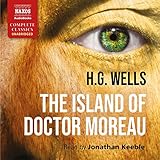
- Audible Audiobook
- H. G. Wells (Author) - Jonathan Keeble (Narrator)
- English (Publication Language)
- 01/15/2021 (Publication Date) - Naxos AudioBooks (Publisher)
The Island of Doctor Moreau by H. G. Wells: Scientific Hubris and Its Consequences
This section delves into the core scientific premise of The Island of Doctor Moreau by H. G. Wells and the ethical quandaries it presents. Moreau’s relentless pursuit of scientific advancement, specifically his attempts to surgically transform animals into human-like beings, serves as the central conflict. His methods, involving vivisection and the imposition of a rigid behavioral code (“The Law”), highlight a dangerous disregard for the inherent nature and suffering of his subjects. The novel functions as a stark warning against the unchecked ambition of science when divorced from moral consideration.
BLOCKQUOTE_0
The text provides concrete examples of Moreau’s experiments, detailing the grotesque results and the perpetual agony of the Beast Folk. This unflinching depiction is crucial to understanding the novel’s message. The takeaway is that scientific progress, while valuable, must be tempered by a deep respect for life and a clear understanding of ethical boundaries. Wells uses Moreau’s island as a microcosm to explore what happens when these boundaries are ignored, illustrating that the pursuit of knowledge without wisdom can lead to monstrous outcomes.
Common Myths Debunked
- Myth: The Island of Doctor Moreau is simply a horror story about grotesque creatures.
- Correction: While the novel contains elements of horror, its primary focus is on the ethical and philosophical implications of scientific overreach. The Beast Folk are tragic figures, not mere monsters, and their plight serves a deeper narrative purpose.
- Evidence: The narrative emphasizes Prendick’s psychological distress and Moreau’s scientific motivations, rather than gratuitous gore, to explore its themes.
- Myth: H. G. Wells was anti-science and feared all technological advancement.
- Correction: Wells was a visionary who foresaw many technological advancements. However, he was deeply concerned with the ethical application of science and warned against its potential for misuse when unchecked by morality and societal responsibility.
- Evidence: His other works, like The War of the Worlds, also explore the double-edged sword of scientific progress and its impact on humanity.
Expert Tips for Analyzing The Island of Doctor Moreau
- Tip 1: Focus on Moreau’s “Law.”
- Actionable Step: Analyze the specific tenets of “The Law” and how they attempt to impose human morality onto animalistic beings.
- Common Mistake to Avoid: Treating “The Law” as a simple plot device; it is central to the novel’s exploration of artificiality versus nature and the psychological impact of imposed order.
- Tip 2: Evaluate Prendick’s evolving perspective.
- Actionable Step: Track Prendick’s internal monologue and reactions to the island’s inhabitants and Moreau’s experiments.
- Common Mistake to Avoid: Assuming Prendick remains a detached observer; his sanity and worldview are profoundly challenged and altered by his experiences.
- Tip 3: Consider the novel’s critique of human nature.
- Actionable Step: Reflect on whether the Beast Folk are truly “lesser” than humans, or if Moreau’s experiments merely amplify existing human flaws and societal constructs.
- Common Mistake to Avoid: Concluding that the novel blames animals; it primarily critiques human ambition, cruelty, and the flawed concept of superiority.
Decision Criteria for The Island of Doctor Moreau by H. G. Wells
- Primary Criterion: Tolerance for Ambiguity. If a reader requires clear-cut resolutions and definitive answers to complex ethical questions, The Island of Doctor Moreau by H. G. Wells might be a challenging read. The novel deliberately leaves many questions about the nature of humanity and the ultimate fate of its characters open to interpretation. For readers who prefer narratives that explore shades of gray and provoke thought rather than provide concrete conclusions, this novel is highly recommended.
Quick Comparison
| Option | Best for | Pros | Watch out |
|---|---|---|---|
| Quick Answer | General use | <em>The Island of Doctor Moreau by H. G. Wells</em> is a cautionary tale examining t… | Mistake to Avoid: Dismissing the novel as mere sensationalism; its philosophi… |
| Who This Is For | General use | The novel questions the definition of humanity through its depiction of surgi… | Mistake to Avoid: Accepting Moreau’s rationalizations without critically asse… |
| What to Check First | General use | Its enduring relevance lies in its prescient exploration of genetic manipulat… | Mistake to Avoid: Viewing them solely as monstrous creations rather than as t… |
| Step-by-Step Plan Analyzing The Island of Doctor Moreau by H G Wells | General use | Readers interested in classic science fiction that explores profound ethical… | Mistake to Avoid: Considering Prendick a passive observer; his experiences fu… |
Decision Rules
- If reliability is your top priority for The Island of Doctor Moreau by H. G. Wells, choose the option with the strongest long-term track record and support.
- If value matters most, compare total ownership cost instead of headline price alone.
- If your use case is specific, prioritize fit-for-purpose features over generic ‘best overall’ claims.
FAQ
- Q: What is the primary ethical dilemma presented in The Island of Doctor Moreau?
- A: The primary dilemma concerns the morality of vivisection and the pursuit of scientific knowledge at the expense of sentient beings’ well-being and natural state. It questions whether humanity can ethically alter other life forms to fit its own designs.
- Q: How does H. G. Wells define “humanity” in the novel?
- A: Wells suggests that humanity is not merely a biological state but involves moral reasoning, self-awareness, and the capacity for empathy. The Beast Folk, despite their human form, often lack these qualities due to their unnatural creation and Moreau’s flawed imposition of “The Law.”
- Q: Is The Island of Doctor Moreau a critique of science itself, or of its application?
- A: The novel is primarily a critique of the application of science when it lacks ethical guidance and moral responsibility. Wells does not condemn scientific inquiry but rather warns against its unchecked pursuit, particularly when it leads to the suffering and dehumanization of others.
- Q: What is the significance of “The Law” in the novel?
- A: “The Law” represents an artificial attempt to impose human order and morality onto creatures that are fundamentally animal. Its strictness and the fear it instills in the Beast Folk highlight the futility of trying to fundamentally change nature through external force, ultimately leading to their psychological distress and instability.
- Q: Who should read The Island of Doctor Moreau by H. G. Wells?
- A: This novel is recommended for readers who appreciate classic science fiction that engages with complex ethical themes, particularly those interested in the historical context of scientific ethics and the philosophical definition of humanity.
- Q: Can the experiments depicted in The Island of Doctor Moreau be achieved with current technology?
- A: While current technology allows for genetic modification and advanced surgical techniques, the direct surgical transformation of animals into human-like beings as depicted by Moreau remains in the realm of science fiction. However, the ethical questions surrounding genetic manipulation and the welfare of experimental subjects are highly relevant today.