George Berkeley’s Philosophical Work
A Treatise Concerning the Principles of Human Knowledge by George Berkeley: Quick Answer
- George Berkeley’s A Treatise Concerning the Principles of Human Knowledge posits that reality is fundamentally mental, consisting of ideas perceived by minds.
- The work challenges the existence of material substance independent of perception, famously stating “to be is to be perceived” (esse est percipi).
- Its contribution is a radical empiricism leading to idealism, significantly impacting epistemology and metaphysics by questioning the nature of objective reality.
Who This Is For
- Students and scholars of philosophy, particularly those examining epistemology, metaphysics, and the history of idealism.
- Readers interested in a foundational text that critically questions the nature of reality and perception, offering a perspective that deviates from common assumptions.
What to Check First
- Core Tenet: Immaterialism: Understand Berkeley’s central thesis: only minds and their ideas exist; physical objects are collections of perceived sensible qualities.
- Critique of Material Substance: Examine Berkeley’s arguments against an unperceived, material substratum underlying sensible qualities, deeming it an incoherent abstraction.
- The Role of God: Grasp the necessity of God’s continuous perception for the existence and stability of the external world in Berkeley’s system, preventing its cessation when unobserved by humans.
- Empiricism’s Limits: Consider how Berkeley extends empiricist principles to a counter-intuitive conclusion that reality is mind-dependent.
For a foundational understanding of Berkeley’s radical empiricism, the original text is essential. You can find a readily available edition of George Berkeley’s A Treatise Concerning the Principles of Human Knowledge to dive into his core arguments.
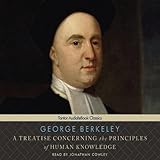
- Audible Audiobook
- George Berkeley (Author) - Jonathan Cowley (Narrator)
- English (Publication Language)
- 09/30/2011 (Publication Date) - Tantor Audio (Publisher)
A Treatise Concerning the Principles of Human Knowledge by George Berkeley: A Principle-Level Explanation
George Berkeley’s A Treatise Concerning the Principles of Human Knowledge, published in 1710, presents a radical empiricist and idealist philosophy. The core assertion is that the physical world does not exist independently of our minds. Berkeley argues that what we commonly identify as “objects” are merely collections of sensible qualities—colors, textures, sounds, smells—which are, by definition, ideas residing within a mind. His famous dictum, “esse est percipi” (to be is to be perceived), encapsulates this view: an entity’s existence is contingent upon its being perceived by a mind.
Berkeley systematically dismantles the concept of material substance, deeming it an incoherent abstraction unsupported by empirical evidence. He posits that the notion of an inert, unthinking substance underpinning qualities is unnecessary. Instead, he proposes that the order, regularity, and persistence of our sensory experiences are sustained by the mind of God. This divine perception guarantees the world’s existence even when individual human minds are not actively perceiving it, preventing the universe from ceasing to exist when we close our eyes.
The Counter-Intuitive Angle: The Illusion of Objective Reality
A counter-intuitive aspect of A Treatise Concerning the Principles of Human Knowledge by George Berkeley that many overlook is its direct challenge to the concept of objective, mind-independent reality. While many philosophical systems, even empiricist ones, grant some form of external existence to the world, Berkeley pushes empiricism to its extreme. He concludes that if we can only ever access our own sensory experiences (ideas), then the existence of anything beyond those ideas is purely speculative and, in his view, superfluous.
This leads to the profound implication that the “external world” is not a collection of physical objects “out there” but rather a consistent and ordered set of perceptions presented to us. The solidity of a table, the redness of an apple, the sound of a bell—these are not properties of some underlying material substance, but the very content of our perceptions. This perspective challenges fundamental assumptions about the world, suggesting that our experience of reality is a mental construct, albeit one governed by divine regularity.
Step-by-Step Plan: Engaging with Berkeley’s Argument
1. Grasp the “Esse est Percipi” Principle: Begin by understanding that Berkeley equates existence with perceivability.
- Action: Read sections where Berkeley introduces and defends “esse est percipi.”
- What to Look For: Explicit statements linking existence to perception by a mind (human or divine).
- Mistake to Avoid: Assuming “perceived” refers only to human perception; remember the crucial role of God’s perception.
2. Analyze the Critique of Abstract Ideas: Follow Berkeley’s arguments against the existence of abstract, general ideas, particularly the idea of matter.
- Action: Examine Berkeley’s refutation of the notion of an unperceiving, material substratum.
- What to Look For: Arguments demonstrating the impossibility of conceiving of qualities without a mind to perceive them, or of matter independent of its qualities.
- Mistake to Avoid: Dismissing this as mere wordplay; Berkeley genuinely believes the concept of material substance is incoherent.
3. Trace the Role of God: Understand why divine perception is essential to Berkeley’s system.
- Action: Identify passages where Berkeley explains the necessity of God for the continuity and order of experience.
- What to Look For: Explanations of how God’s constant perception provides a stable reality, preventing the world from ceasing to exist when unobserved by humans.
- Mistake to Avoid: Underestimating God’s role; for Berkeley, God is not an optional add-on but a foundational element of his philosophy.
4. Consider the Implications for Science: Evaluate how Berkeley’s philosophy affects our understanding of scientific inquiry.
- Action: Reflect on what “natural laws” mean in a world of ideas.
- What to Look For: Berkeley’s view that laws of nature are regularities in the succession of ideas, observable and predictable, but not indicative of underlying material causes.
- Mistake to Avoid: Assuming Berkeley rejects science; he reinterprets its foundations, focusing on the observable regularities of experience.
5. Examine the Nature of the Self: Understand Berkeley’s view of the thinking substance (the soul or mind).
- Action: Read Berkeley’s description of the active, perceiving mind.
- What to Look For: Contrasts between the passive nature of ideas and the active nature of the mind that perceives them.
- Mistake to Avoid: Confusing the mind with the ideas it perceives; Berkeley clearly distinguishes the two.
Common Mistakes
- Mistake: Equating Berkeley’s idealism with solipsism.
- Why it Matters: Solipsism is the belief that only one’s own mind is sure to exist, a radical skepticism about other minds and the external world. Berkeley’s system explicitly includes other finite minds and God’s infinite mind, preventing this collapse.
- Fix: Recognize that Berkeley’s inclusion of God and other minds differentiates his philosophy from solipsism.
- Mistake: Dismissing Berkeley’s arguments as mere semantic games.
- Why it Matters: Berkeley’s critique of material substance is a genuine philosophical challenge to the prevailing scientific and philosophical assumptions of his era, rooted in logical deduction from empiricist premises.
- Fix: Engage with his arguments seriously, attempting to understand the logical steps he takes from empiricist foundations.
- Mistake: Assuming Berkeley denies the existence of the “external world” entirely.
- Why it Matters: Berkeley does not deny the world’s existence; he redefines it, grounding it in perception rather than material substance. For him, the “external world” is a stable, ordered collection of ideas.
- Fix: Understand that for Berkeley, the “external world” is a consistent set of perceptions, guaranteed by divine perception.
- Mistake: Overlooking the crucial role of God in Berkeley’s system.
- Why it Matters: Without God’s constant perception, Berkeley’s world would be unstable and subject to individual human perception, potentially leading to chaos or solipsism.
- Fix: Acknowledge God as the ultimate guarantor of reality, order, and continuity in Berkeley’s philosophy.
Expert Tips
- Tip: Focus on Berkeley’s empirical foundations to understand his idealism.
- Action: When reading, constantly ask: “What sensory experience supports this claim?” Berkeley argues that we experience only ideas, not material substance.
- Common Mistake: Treating Berkeley’s idealism as a purely speculative metaphysical leap, rather than a logical extension of empiricist principles.
- Tip: Grasp the distinction between active and passive faculties of the mind.
- Action: Pay close attention to how Berkeley describes the mind as an active, perceiving agent and ideas as passive objects of perception.
- Common Mistake: Confusing the mind (the subject) with the ideas (the objects) it perceives, leading to a misunderstanding of his dualistic ontology of minds and ideas.
- Tip: Recognize the argumentative strategy of reductio ad absurdum against material substance.
- Action: Identify where Berkeley attempts to show that the concept of matter leads to absurd or incoherent conclusions, thereby undermining its existence.
- Common Mistake: Engaging with the concept of material substance as if Berkeley accepts its possibility and is merely debating its properties, rather than arguing for its fundamental non-existence.
Strengths and Limitations
| Aspect | Description | Evidence/Example |
|---|---|---|
| Strengths | Radical empiricist grounding | Berkeley derives his idealism directly from the empiricist premise that all knowledge comes from sensory experience. He systematically questions what can be experienced. |
| Coherent system | His idealism, once accepted, forms a logically consistent worldview where only minds and ideas exist, supported by divine perception. | |
| Epistemological challenge | The work forces a re-evaluation of the relationship between mind, perception, and reality, influencing subsequent philosophical thought. | |
| Limitations | Counter-intuitive conclusions | The assertion that material objects do not exist independently of perception is difficult for many to accept and challenges common sense. |
| Reliance on God | The necessity of divine perception to maintain a stable universe can be seen as a metaphysical assumption not strictly derivable from empirical observation alone. |
Decision Rules
- If reliability is your top priority for A Treatise Concerning the Principles of Human Knowledge by George Berkeley, choose the option with the strongest long-term track record and support.
- If value matters most, compare total ownership cost instead of headline price alone.
- If your use case is specific, prioritize fit-for-purpose features over generic ‘best overall’ claims.