Finding What Matters: Mark Manson’s Subtle Art
Quick Answer
- Mark Manson’s The Subtle Art Of Not Giving A FCk* advocates for a counter-intuitive approach to a better life: accepting limitations and choosing what truly matters.
- The book challenges conventional self-help by promoting strategic indifference, not apathy, urging readers to allocate their limited emotional and mental energy wisely.
- It provides a practical framework for identifying core values and taking responsibility for one’s choices, leading to a more resilient and authentic existence.
Who This Is For
- Individuals feeling overwhelmed by societal pressures to be happy, successful, or engaged with every issue, leading to anxiety and burnout.
- Readers seeking a direct, no-nonsense perspective on self-improvement that prioritizes personal responsibility and realistic expectations over platitudes.
What To Check First
- Core Premise: Understand that “not giving a f*ck” is not about apathy or indifference to all things, but about the deliberate and strategic allocation of one’s limited emotional and mental resources. It’s about choosing what is truly important.
- Value Hierarchy: Identify your fundamental values. The book posits that what you choose to care about defines your life and dictates where your energy should be directed.
- Acceptance of Suffering: Recognize that struggle, pain, and discomfort are inherent and unavoidable parts of the human experience, not necessarily indicators of a problem or a life gone wrong.
- Personal Responsibility: Acknowledge that you are the primary architect of your own experience through your choices and reactions, regardless of external circumstances.
Step-by-Step Plan
1. Acknowledge Your Limitations and Inevitable Suffering:
- Action: Consciously identify areas in your life where you have no control or significant limitations. Simultaneously, recognize that pain and difficulty are not exceptions but constants in life.
- Look for: Examples of wasted energy spent on trying to change the unchangeable or situations where you’ve resisted necessary discomfort. For instance, trying to control a colleague’s behavior or feeling devastated by a minor inconvenience.
- Mistake: Believing that a happy life means the absence of struggle or that you can or should fix every external problem. This leads to constant frustration and a sense of victimhood.
2. Choose Your Battles Wisely (The “F*ck Budget”):
- Action: Determine which problems, values, or goals are genuinely worth your limited emotional and mental resources. This involves a conscious decision about what you will and will not prioritize.
- Look for: What truly aligns with your core values and contributes to a meaningful life, even if it involves difficulty. For example, prioritizing a demanding but rewarding career path over constant social media validation.
- Mistake: Giving equal importance and emotional energy to trivial matters, external opinions, or superficial concerns, thus depleting your capacity for what truly matters.
3. Embrace and Learn from Negative Experiences:
- Action: Accept that negative emotions, failures, and difficult experiences are inevitable and can serve as valuable teachers for growth and self-awareness.
- Look for: How past negative experiences have provided crucial lessons, strengthened resilience, or clarified your values. For example, a failed business venture teaching you about market research and financial management.
- Mistake: Constantly seeking to avoid discomfort, pain, or negative emotions, which leads to a fragile psyche and an inability to cope with life’s inherent challenges.
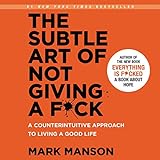
The Subtle Art of Not Giving a F*ck: A Counterintuitive Approach to Living a Good Life
- Audible Audiobook
- Mark Manson (Author) - Roger Wayne (Narrator)
- English (Publication Language)
- 09/13/2016 (Publication Date) - Harper (Publisher)
4. Define and Commit to Your Values:
- Action: Clearly articulate the principles that will guide your life and decisions. This requires introspection and honesty about what you fundamentally believe in.
- Look for: Consistency between your stated values and your actions. If honesty is a value, look for situations where you are acting truthfully, even when it’s difficult.
- Mistake: Adopting societal, familial, or peer-group values that do not genuinely resonate with your inner self, leading to internal conflict and a lack of authenticity.
5. Practice Selective Indifference and Boundary Setting:
- Action: Deliberately choose to stop caring about or expending energy on things that do not serve your core values, well-being, or goals. This involves setting clear boundaries.
- Look for: Opportunities to disengage from unnecessary drama, external pressures, or opinions that are not constructive. For example, choosing not to engage in online arguments about non-essential topics.
- Mistake: Confusing selective indifference with apathy or a lack of care for anything. True selective indifference is an active choice about where to focus your care, not a general disengagement from life.
6. Accept Radical Responsibility for Your Choices and Outcomes:
- Action: Own the consequences of your decisions, both positive and negative, without resorting to blame, excuses, or victimhood.
- Look for: Patterns of behavior and outcomes that stem directly from your own choices. For example, acknowledging that a missed deadline was due to your procrastination.
- Mistake: Shifting blame for negative outcomes onto others, circumstances, or external factors, which disempowers you and prevents learning and growth.
The Subtle Art Of Not Giving A F*Ck by Mark Manson: Challenging Conventional Wisdom
Myth 1: The book advocates for apathy and a complete lack of concern for anything.
- Why it matters: This is a fundamental misinterpretation that can lead to disengagement, irresponsibility, and a nihilistic outlook, rather than the book’s intended outcome of focused effort.
- Fix: Understand that “not giving a f*ck” is not about being indifferent to everything, but about being highly selective and strategic about what you allow to occupy your limited emotional and mental energy. It’s about prioritizing what truly matters and letting go of the rest.
Myth 2: The book’s message encourages rudeness, selfishness, and a disregard for others.
- Why it matters: This misreading can lead to destructive interpersonal relationships, alienating others and creating a negative social environment, which is counterproductive to a meaningful life.
- Fix: Manson advocates for honesty, directness, and setting boundaries, but not for gratuitous rudeness or a lack of empathy. The focus is on authentic self-expression and managing one’s own well-being, which, when done healthily, can lead to more genuine connections, not fewer.
Myth 3: The Subtle Art Of Not Giving A FCk by Mark Manson* offers a quick, effortless fix for all of life’s problems.
- Why it matters: This sets unrealistic expectations, leading to disappointment and a belief that the book’s principles are ineffective when, in reality, they require consistent effort and self-reflection.
- Fix: The book provides a philosophical framework and practical tools for navigating life’s inherent difficulties. It is not a magic wand but a guide that requires ongoing application, introspection, and a willingness to confront uncomfortable truths.
Expert Tips for Applying The Subtle Art Of Not Giving A F*Ck by Mark Manson
- Tip 1: Implement a “Value Audit” Regularly.
- Actionable Step: Dedicate 15 minutes each week to review your recent activities and emotional investments. Ask yourself: “Did this activity align with my most important values? Was it worth the energy I expended?”
- Common Mistake to Avoid: Performing this audit only once or believing that your values are static. Values can evolve, and so should your “f*ck budget.” Failing to adapt leads to misaligned efforts.
- Tip 2: Reframe “Failure” as a Data Point for Improvement.
- Actionable Step: When an endeavor results in an outcome you did not desire, instead of labeling it a “failure” and feeling defeated, ask: “What specific information does this outcome provide about my approach, my understanding, or the external conditions?”
- Common Mistake to Avoid: Internalizing negative outcomes as evidence of personal inadequacy. This leads to fear of trying new things and a perpetuation of the same mistakes because the learning opportunity is missed.
- Tip 3: Practice “Controlled Discomfort” to Build Resilience.
- Actionable Step: Intentionally engage in minor, manageable discomforts for brief, predetermined periods. Examples include: taking a slightly colder shower for 30 seconds, sitting in silence without distraction for five minutes, or delaying a gratification for a short time.
- Common Mistake to Avoid: Immediately seeking comfort or escaping the discomfort as soon as it arises. This reinforces a low tolerance for life’s inevitable challenges and prevents the development of mental fortitude.
The Subtle Art Of Not Giving A F*Ck by Mark Manson: Principles in Action
| Core Principle | Description | Concrete Example | Common Pitfall to Avoid |
|---|---|---|---|
| Value Prioritization | Consciously choosing what is truly important and allocating your energy accordingly. | Deciding to prioritize deep work on a creative project over attending every social event, recognizing the former aligns with a core value. | Mistaking fleeting desires or external pressures for genuine, enduring values. |
| Acceptance of Reality | Acknowledging and accepting limitations, imperfections, and the inevitability of suffering and negative experiences. | Not getting overly distressed by minor inconveniences like traffic jams, understanding they are part of daily life and beyond immediate control. | Resisting or denying reality, leading to unnecessary frustration, anger, and a wasted expenditure of emotional energy. |
| Radical Responsibility | Taking full ownership of your choices, actions, and their consequences, without blaming others or external factors. | Admitting fault for a missed deadline due to procrastination, rather than blaming a lack of resources or external distractions. | Perpetuating a victim mentality by consistently attributing negative outcomes to external forces or other people. |
| Selective Focus | Deliberately choosing what to care |
Decision Rules
- If reliability is your top priority for The Subtle Art Of Not Giving A F*Ck by Mark Manson, choose the option with the strongest long-term track record and support.
- If value matters most, compare total ownership cost instead of headline price alone.
- If your use case is specific, prioritize fit-for-purpose features over generic ‘best overall’ claims.