Exploring The World Of Winnie The Pooh
This analysis delves into The World Of Winnie The Pooh by A. A. Milne, examining its literary construction, thematic underpinnings, and suitability for its intended audience. It aims to provide a balanced perspective, identifying specific narrative strengths and potential limitations beyond superficial engagement.
The World Of Winnie The Pooh by A. A. Milne: Who This Is For
- This exploration is designed for readers interested in the enduring literary significance and foundational impact of The World Of Winnie The Pooh by A. A. Milne, particularly those who value classic children’s literature.
- It also serves parents and educators assessing the book for younger readers, offering insights into its thematic complexity and age-appropriateness.
What To Check First
- Authorial Intent and Inspiration: A. A. Milne’s creation of the Hundred Acre Wood was deeply personal, inspired by his son Christopher Robin and his toys. Understanding this intimate origin is crucial for appreciating the book’s unique spirit.
- Narrative Structure and Voice: Milne employs a distinct narrative voice that directly addresses the reader, creating a metafictional layer. This technique is central to the book’s charm and structural integrity.
- Character Archetypes and Depth: Each inhabitant of the Hundred Acre Wood—Pooh, Piglet, Eeyore, Tigger, Rabbit, Owl, Kanga, and Roo—represents distinct personality traits. Examining their interactions reveals relatable human qualities beyond simple archetypes.
- Thematic Resonance: Beyond simple adventures, the book explores universal themes such as friendship, loyalty, loss, and the navigation of the world from a child’s perspective, offering layers of meaning.
- Illustrative Partnership: The original illustrations by E. H. Shepard are integral to the storytelling, visually interpreting characters and atmosphere, and should be considered alongside the text.
Step-by-Step Plan for Analyzing The World Of Winnie The Pooh by A. A. Milne
1. Deconstruct the Narrative Voice:
- Action: Pay close attention to the narrator’s direct addresses to the reader in the opening chapters.
- What to look for: Observe how Milne establishes the world and characters through a conversational, often self-aware tone, including asides and reflections.
- Mistake to avoid: Treating the narrator as an invisible, omniscient entity; his active presence is a deliberate narrative choice that shapes reader engagement.
2. Examine Character Dynamics:
- Action: Focus on specific dialogues and interactions between characters, such as Pooh’s conversations with Piglet or Eeyore’s pronouncements.
- What to look for: Identify the underlying relational patterns—Pooh’s simple logic, Piglet’s timidity coupled with loyalty, Eeyore’s resigned perspective.
- Mistake to avoid: Underestimating the emotional subtext; these interactions are the foundation of the stories’ long-term relevance and relatability.
3. Interpret Pooh’s “Thinkings”:
- Action: Analyze Pooh’s characteristic “thinkings” and seemingly simple observations, especially those concerning honey, friendship, and problem-solving.
- What to look for: Recognize the understated wisdom in his pronouncements, often rooted in immediate sensory experiences or fundamental truths.
- Mistake to avoid: Dismissing Pooh’s thoughts as mere childishness; they frequently represent an intuitive, unburdened form of logic.
4. Trace Thematic Development:
- Action: Identify recurring motifs such as the importance of companionship, the comfort found in routine, and the gentle exploration of childhood anxieties.
- What to look for: Observe how themes of loyalty, acceptance of individual differences, and the nature of courage are woven through the various episodes.
- Mistake to avoid: Perceiving the stories as purely episodic without recognizing the consistent exploration of these core human values.
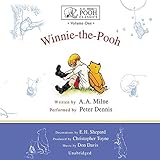
Winnie-the-Pooh: A.A. Milne's Pooh Classics, Volume 1
- Audible Audiobook
- A. A. Milne (Author) - Peter Dennis (Narrator)
- English (Publication Language)
- 01/01/2004 (Publication Date) - Bother! LA Production (Publisher)
5. Integrate E. H. Shepard’s Illustrations:
- Action: Actively consider E. H. Shepard’s original illustrations in conjunction with the text.
- What to look for: Observe how Shepard’s distinctive line drawings visually embody the characters’ personalities and contribute to the gentle, nostalgic atmosphere of the Hundred Acre Wood.
- Mistake to avoid: Underestimating the symbiotic relationship between Milne’s text and Shepard’s art; they are mutually constitutive elements of the work’s overall impact.
6. Evaluate Reader Suitability:
- Action: Assess the vocabulary, sentence structure, and thematic complexity in relation to a child’s developmental stage and reading readiness.
- What to look for: Determine whether the narrative requires a certain level of comprehension to fully appreciate the narrator’s voice, subtle humor, and emotional nuances.
- Mistake to avoid: Assuming universal suitability for all young children without considering individual reading abilities and attention spans.
Common Myths About The World Of Winnie The Pooh
- Myth: Winnie-the-Pooh is solely a collection of lighthearted, nonsensical tales for very young children.
- Why it matters: This perception overlooks the sophisticated narrative structure, the exploration of complex emotions like anxiety and melancholy, and the nuanced character development that offers layers of meaning.
- Fix: Recognize the layered storytelling where simple adventures serve as vehicles for exploring themes of friendship, loyalty, and the challenges of growing up, as exemplified in Pooh’s quiet contemplations and Piglet’s bravery.
- Myth: The characters are one-dimensional representations of childhood traits.
- Why it matters: This view fails to acknowledge the subtle character arcs and the relatable human qualities each character embodies, even within their archetypal roles.
- Fix: Observe how characters like Eeyore, despite his persistent gloom, finds moments of connection, or how Piglet, despite his timidity, demonstrates profound bravery when his friends are in need, illustrating depth beyond simple archetypes.
- Myth: The narrator’s voice is merely a conventional storytelling device with no deeper significance.
- Why it matters: Milne’s direct address to the reader is a deliberate metafictional technique that blurs the lines between reality and imagination, inviting the reader into the creative process and adding intellectual engagement.
- Fix: Appreciate how the narrator’s interjections and reflections—such as his musings on the nature of stories or his relationship with Christopher Robin—add a layer of intellectual engagement and emotional depth to the narrative, enhancing the reading experience.
Decision Criteria for Engagement with The World Of Winnie The Pooh
- If thematic depth is your priority for The World Of Winnie The Pooh by A. A. Milne, focus on how Milne uses simple scenarios to explore complex emotions and relationships, offering rich ground for discussion.
- If narrative innovation is a key consideration, prioritize the unique metafictional structure and the author’s direct engagement with the reader, which sets it apart from many children’s books.
- If ease of comprehension for early readers is paramount, consider that while the stories are charming, the nuanced language and narrative voice may be better suited for read-aloud sessions or for more advanced young readers.
Expert Tips for Appreciating The World Of Winnie The Pooh
- Tip: Engage with the author’s framing device.
- Action: Read the introductory chapters with an awareness of Milne’s presence as a narrator who is also a character in his own narrative.
- Mistake to avoid: Treating the narrator as a standard, unobtrusive storyteller; his interjections are crucial to the book’s unique structure and charm.
- Tip: Analyze the subtext of character interactions.
- Action: Look beyond the surface of conversations to understand the unspoken emotions and motivations driving the characters, particularly in moments of conflict or comfort.
- Mistake to avoid: Assuming characters act solely on immediate impulses; their actions often reveal deeper loyalties and vulnerabilities.
- Tip: Consider the illustrations as narrative partners.
- Action: Observe how E. H. Shepard’s drawings complement and extend the textual descriptions, adding visual cues to character personality and emotional tone.
- Mistake to avoid: Viewing the illustrations as mere embellishments; they are integral to the storytelling and the overall atmosphere of the Hundred Acre Wood.
Quick Comparison
| Book Title | Target Audience | Primary Strengths | Potential Weaknesses |
|---|---|---|---|
| The World Of Winnie The Pooh by A. A. Milne | Ages 6-9 (read-aloud), 7-9 (independent) | Nuanced characterization, sophisticated narrative voice, exploration of friendship and childhood anxieties. | May require adult guidance for younger readers to fully grasp thematic depth and narrative structure. |
| The House at Pooh Corner | Ages 6-9 (read-aloud), 7-9 (independent) | Focus on growing up and change, continued exploration of friendship, emotional maturity. | Similar to the first book, subtle themes may be missed by very young children. |
| When We Were Very Young (Poetry) | Ages 4+ | Whimsical verse, introduction to Milne’s world and characters. | Less narrative cohesion than the prose books, primarily for enjoyment of language and imagery. |
BLOCKQUOTE_0
This quote highlights the subtle exploration of loneliness and the value of companionship that permeates the book, underscoring its emotional depth beyond simple adventures.
Decision Rules
- If reliability is your top priority for The World Of Winnie The Pooh by A. A. Milne, choose the option with the strongest long-term track record and support.
- If value matters most, compare total ownership cost instead of headline price alone.
- If your use case is specific, prioritize fit-for-purpose features over generic ‘best overall’ claims.
FAQ
- Q: Is The World Of Winnie The Pooh by A. A. Milne suitable for independent reading by a 6-year-old?
- A: While a 6-year-old may enjoy being read to, independent reading might be challenging due to the nuanced language and narrative voice. It is generally more appropriate for children aged 7-9 for independent reading, or for younger children when read aloud.