Exploring The Foundations Of Morality
Quick Answer
- Core Argument: Jonathan Sacks’s Morality posits that ethics are a deliberate human creation, essential for civilization, rather than an innate biological feature.
- Key Takeaway: A shared moral framework, transmitted through culture and community, is presented as the bedrock of societal stability and progress.
- Contrarian Consideration: The emphasis on communal transmission and covenantal ethics may lead some readers to overlook the potential for innate human empathy and individual moral reasoning independent of societal structures.
Who This Is For
- Readers interested in a philosophical and theological exploration of the foundations of ethics and societal order.
- Individuals seeking to understand how culture, religion, and history have shaped moral frameworks across civilizations.
What To Check First
- Author’s Perspective: Rabbi Lord Jonathan Sacks, an Orthodox Jewish scholar, frames morality through a lens of covenant, community, and the transmission of values.
- Book’s Scope: Morality is an analytical work on the necessity of collective ethics, not a prescriptive guide for individual moral dilemmas.
- Central Thesis: The book asserts that morality is a prerequisite for civilization, a deliberate human creation rather than a simple evolutionary byproduct.
- Contrast with Innate Morality: Be aware that Sacks critiques purely biological or instinctual explanations for morality, favoring a view rooted in social agreement and historical development.
Step-by-Step Plan: Understanding Morality by Jonathan Sacks
1. Examine the Social Genesis of Morality:
- Action: Read Sacks’s argument that morality is a cultural artifact, developed and maintained by human societies.
- What to Look For: Understand how Sacks connects the rise of civilization with the emergence of shared moral codes, such as the development of early legal systems.
- Mistake to Avoid: Assuming morality is a fixed, unchanging entity rather than a dynamic social construct requiring active cultivation and adaptation.
2. Analyze the Covenantal Framework:
- Action: Study Sacks’s concept of morality as a form of “covenant”—a binding agreement that creates mutual obligations.
- What to Look For: Identify how this covenantal model, as seen in historical agreements and social contracts, underpins social cohesion and responsibility in his view.
- Mistake to Avoid: Equating “covenant” solely with religious pacts, without recognizing its broader application to societal contracts and shared commitments that form the basis of community.
3. Appreciate the Role of Narrative and Memory:
- Action: Focus on Sacks’s emphasis on stories, rituals, and collective memory as mechanisms for transmitting moral values.
- What to Look For: Observe how narratives, such as foundational myths or historical accounts, shape moral understanding and behavior across generations.
- Mistake to Avoid: Underestimating the power of cultural transmission and storytelling as essential for embedding ethical principles beyond simple intellectual assent.
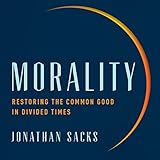
- Audible Audiobook
- Jonathan Sacks (Author) - Jonathan Sacks (Narrator)
- English (Publication Language)
- 09/01/2020 (Publication Date) - Basic Books (Publisher)
4. Evaluate the “Thou Shalt Nots”:
- Action: Consider Sacks’s perspective on prohibitions (“thou shalt nots”) as fundamental to establishing societal boundaries.
- What to Look For: Recognize the pragmatic role Sacks assigns to these prohibitions in preventing social breakdown and defining acceptable conduct.
- Mistake to Avoid: Viewing prohibitions only as restrictive, rather than as necessary safeguards for communal well-being as argued by Sacks, which enable positive freedoms.
5. Grasp the “We” Over the “I”:
- Action: Understand Sacks’s assertion that morality prioritizes the collective good and communal identity.
- What to Look For: Note how this contrasts with modern trends toward radical individualism and the potential societal consequences.
- Mistake to Avoid: Interpreting “collective good” as a mandate to suppress individual rights, rather than as a necessary balance for a functioning society that also upholds individual dignity.
6. Address the “Moral Illiteracy” Threat:
- Action: Identify Sacks’s warning about the dangers of losing a shared moral compass.
- What to Look For: Recognize the symptoms of moral decline he describes, such as increased selfishness, social fragmentation, and the erosion of shared values.
- Mistake to Avoid: Underestimating the fragility of moral consensus and the continuous effort required for its maintenance and transmission.
Failure Mode: Over-Emphasis on External Mandates
A primary failure mode readers may encounter when engaging with Morality by Jonathan Sacks is the tendency to overemphasize his arguments for externally imposed moral frameworks, potentially neglecting the intrinsic capacity for empathy and individual ethical reasoning. Sacks strongly advocates for shared moral codes, viewing them as vital for civilization’s survival and transmission.
Detection: This misinterpretation can occur if readers:
- Focus exclusively on Sacks’s emphasis on covenant and communal obligation, overlooking his nuanced discussions on human dignity and the inherent value of the individual.
- Interpret his call for a shared moral language as a demand for a singular, universally dictated ethical system, rather than a framework for dialogue and mutual understanding.
- Fail to connect his theological underpinnings to the broader philosophical implications for secular societies striving for common ethical ground.
Correction: To avoid this, actively seek out Sacks’s passages that explore the internalization of moral principles and the cultivation of empathy. Recognize that his vision of morality aims to enable human flourishing, not merely enforce compliance. The book’s strength lies in articulating why a shared moral language is vital, but its limitation appears if this is misunderstood as a dismissal of individual ethical agency or the capacity for reasoned moral judgment.
Morality by Jonathan Sacks: A Foundational Examination
Jonathan Sacks, in his work Morality, presents a compelling case that ethics are not hardwired into human biology but are rather a sophisticated social construct, developed and sustained by communities. He argues that our capacity for morality is learned and cultivated, essential for the very fabric of civilization. This perspective challenges innate or purely instinctual theories of ethics, positioning morality as a deliberate human achievement.
- Evidence: Sacks draws on historical and anthropological examples, illustrating how diverse societies have codified ethical practices to manage social order and foster cooperation. For instance, he discusses the development of legal and moral codes in ancient civilizations as a response to the need for stability, such as the Ten Commandments serving as a foundational set of directives for early Israelite society.
- Takeaway: This view underscores the critical role of culture, education, and shared narratives in shaping ethical behavior. It implies that societal moral decline is often a failure of cultural transmission and communal commitment, rather than an inevitable consequence of human nature.
The Covenantal Basis of Ethics
A central thesis in Sacks’s work is that morality is fundamentally “covenantal”—a system of mutual obligations and responsibilities that bind individuals to one another and to a shared vision. This concept, deeply rooted in his Jewish heritage, posits that ethical living is not merely a matter of individual choice or divine decree but of reciprocal relationship and commitment.
BLOCKQUOTE_0
- Evidence: Sacks elaborates on the biblical concept of covenant, particularly the covenant at Sinai, as a model for establishing a moral community. He explains how this framework creates shared responsibilities and a common purpose that transcends individual desires, fostering a sense of collective identity and duty.
- Takeaway: This perspective highlights the importance of community and shared commitments in grounding moral life. It suggests that ethical systems are most robust when they foster a sense of collective responsibility and mutual reliance, moving beyond mere contractual agreements to deeper relational bonds.
The Transmission of Moral Values
Sacks places significant emphasis on the mechanisms through which moral values are transmitted across generations. He argues that stories, rituals, and collective memory are indispensable tools for imbuing ethical principles with meaning and ensuring their perpetuation. Abstract rules, he contends, become internalized and actionable when embedded within compelling narratives and enacted through communal practices.
- Evidence: He points to the function of religious texts, national histories, and cultural traditions as vital vehicles for moral education. For example, the Passover Seder, with its narrative of liberation and commandment, serves as a powerful ritualistic reinforcement of values related to justice and freedom for Jewish families.
- Takeaway: This underscores the necessity of robust cultural institutions and practices that actively engage individuals in moral reflection and reinforce shared ethical commitments, moving beyond mere intellectual assent to embodied understanding.
Common Myths
- Myth 1: Morality is purely subjective and varies entirely from person to person, making universal ethics impossible.
- Correction: While individual interpretations and cultural expressions of morality differ, Sacks argues that fundamental moral principles are necessary for any society to function. These principles address universal human needs for order, justice, and cooperation. The book demonstrates that without shared moral anchors, societies tend towards chaos. For example, the prohibition against murder is a near-universal moral imperative.
- Myth 2: Morality is exclusively dictated by religious texts and is irrelevant in secular contexts.
- Correction: Sacks’s work, while drawing on religious traditions, explores universal themes of morality applicable to secular societies. He argues that the function of morality—promoting social cohesion and human flourishing—is a shared concern, regardless of the ultimate source of ethical authority. The book emphasizes the shared human need for a moral framework, whether derived from divine revelation or reasoned societal agreement.
Expert Tips
- Tip 1: Focus on the “why” behind moral rules, not just the “what.”
- Actionable Step: When encountering a moral principle in Sacks’s work, ask: “What societal or human need does this principle address?” For instance, consider why prohibitions against theft are crucial for economic stability.
- Common Mistake to Avoid: Treating moral codes as arbitrary rules without understanding their foundational role in enabling human coexistence and flourishing.
- Tip 2: Recognize the intergenerational aspect of morality.
- Actionable Step: Consider how the moral values you hold were transmitted to you and how you might
Quick Comparison
| Option | Best for | Pros | Watch out |
|---|---|---|---|
| Quick Answer | General use | Core Argument: Jonathan Sacks’s Morality posits that ethics are a deliberat… | Mistake to Avoid: Assuming morality is a fixed, unchanging entity rather than… |
| Who This Is For | General use | Key Takeaway: A shared moral framework, transmitted through culture and commu… | Mistake to Avoid: Equating “covenant” solely with religious pacts, without re… |
| What To Check First | General use | Contrarian Consideration: The emphasis on communal transmission and covenanta… | Mistake to Avoid: Underestimating the power of cultural transmission and stor… |
| Step-by-Step Plan Understanding Morality by Jonathan Sacks | General use | Readers interested in a philosophical and theological exploration of the foun… | Mistake to Avoid: Viewing prohibitions only as restrictive, rather than as ne… |
Decision Rules
- If reliability is your top priority for Morality by Jonathan Sacks, choose the option with the strongest long-term track record and support.
- If value matters most, compare total ownership cost instead of headline price alone.
- If your use case is specific, prioritize fit-for-purpose features over generic ‘best overall’ claims.