Exploring Emily Tesh’s ‘Some Desperate Glory
Some Desperate Glory by Emily Tesh: Quick Answer
- Core Focus: Explores the psychological impact of inherited trauma and cycles of violence within a militaristic society.
- Protagonist: Features a challenging, deeply conditioned protagonist whose journey is central to the narrative’s thematic exploration.
- Reader Experience: Offers a complex, character-driven science fiction narrative that prioritizes thematic depth over conventional plot pacing.
Who This Is For
- Readers seeking science fiction that delves into the psychological weight of inherited conflict and societal conditioning.
- Those interested in narratives that question the nature of heroism and the possibility of breaking deeply ingrained cycles of hatred.
What to Check First
- Narrative Perspective: The story is told from the perspective of Kyr, a protagonist shaped by generations of war and indoctrination. Her internal monologue and actions are key to understanding the novel.
- Thematic Emphasis: The book heavily emphasizes themes of inherited trauma, the glorification of violence, and the struggle for individual identity against a prescribed destiny.
- World-Building Context: The society depicted is built around perpetual conflict with a designated “Great Enemy.” This context is crucial for understanding character motivations and societal structures.
- Pacing and Structure: The narrative is deliberate and can be non-linear, focusing on Kyr’s internal state and philosophical questions rather than constant external action.
Step-by-Step Plan for Engaging with Some Desperate Glory
This guide provides a structured approach to analyzing Emily Tesh’s Some Desperate Glory, focusing on its thematic complexity and character development.
1. Understand Kyr’s Conditioning: Begin by recognizing that Kyr is a product of her environment.
- Action: Read the opening chapters with an awareness of Kyr’s ingrained hatred and her society’s militaristic values.
- What to Look For: Observe Kyr’s immediate reactions, her internal justifications for violence, and how she views the ‘Great Enemy’ as evidence of her upbringing.
- Mistake: Expecting Kyr to be immediately relatable or conventionally heroic. Her challenging nature is intentional and serves the narrative’s exploration of trauma.
2. Analyze the Societal Framework: Deconstruct the world that shapes Kyr.
- Action: Pay close attention to the descriptions of the Guardians, the concept of ‘glory,’ and the perpetual war.
- What to Look For: How does the society’s obsession with revenge and past grievances dictate its present actions and the lives of its citizens?
- Mistake: Treating the world-building as mere backdrop. The meticulously constructed, war-centric society is fundamental to understanding Kyr’s internal and external conflicts.
3. Identify Inherited Trauma: Track the recurring motifs of generational conflict and its psychological toll.
- Action: Note instances where Kyr’s thoughts or actions directly echo the beliefs or traumas of her ancestors.
- What to Look For: Connections between historical conflicts and present-day attitudes, the psychological burden of perpetual warfare, and the difficulty of breaking these cycles.
- Mistake: Focusing solely on plot events without recognizing the deeper thematic currents of inherited hatred and the struggle for individual agency.
4. Engage with the Narrative Structure: Understand the purpose of the non-linear elements.
- Action: Be patient with shifts in time and perspective, observing how they reveal Kyr’s past and influence her present.
- What to Look For: How do flashbacks or fragmented memories illuminate Kyr’s development and the complexities of her internal world?
- Mistake: Becoming frustrated by the fragmented structure. It is a deliberate tool to explore memory, trauma, and the layered nature of Kyr’s psyche.
5. Examine Character Relationships: Observe how Kyr’s interactions reveal her evolving understanding.
- Action: Analyze Kyr’s relationships with other characters, particularly those who challenge her worldview.
- What to Look For: Signs of Kyr questioning her conditioning, moments of unexpected empathy, and the difficulties of forming genuine connections outside of conflict.
- Mistake: Dismissing supporting characters as mere plot devices. Their interactions with Kyr are crucial for her growth and the exploration of the novel’s themes.
6. Critically Assess ‘Glory’: Understand the subversion of the titular concept.
- Action: Question what ‘glory’ truly signifies within the novel’s context, contrasting the societal definition with Kyr’s potential redefinition.
- What to Look For: Instances where the pursuit of glory leads to destruction versus moments where true fulfillment might lie elsewhere.
- Mistake: Accepting the societal definition of glory at face value, thereby missing the novel’s critique of militaristic honor and its destructive impact.
7. Reflect on the Resolution: Consider the implications of the novel’s conclusion.
- Action: Evaluate the ending in light of Kyr’s journey and the themes explored throughout the book.
- What to Look For: The extent to which Kyr has genuinely begun to break free from her inherited trauma and the potential for future change.
- Mistake: Expecting a simple or conventionally triumphant resolution. The novel’s power lies in its nuanced portrayal of the difficulty of overcoming deeply ingrained conflicts.
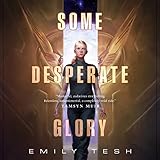
- Audible Audiobook
- Emily Tesh (Author) - Sena Bryer (Narrator)
- English (Publication Language)
- 04/11/2023 (Publication Date) - Macmillan Audio (Publisher)
Some Desperate Glory by Emily Tesh: Thematic Deep Dive
Emily Tesh’s Some Desperate Glory presents a stark and unflinching look at the pervasive nature of inherited trauma within a militaristic society. The narrative centers on Kyr, a protagonist whose identity is forged in the crucible of an unending war against a designated “Great Enemy.” The societal obsession with ‘glory’ is not an abstract ideal but a deeply ingrained ideology, passed down through generations like a biological imperative. Tesh’s skill lies in illustrating how this inherited hatred shapes not only societal structures but also the individual psyche, making Kyr’s journey one of profound internal struggle. The novel excels in its exploration of the psychological weight of perpetual conflict, offering a counterpoint to more traditional space opera narratives by focusing on the arduous, often non-linear, path toward healing and self-discovery.
The primary strength of Some Desperate Glory by Emily Tesh is its commitment to portraying a protagonist who is initially defined by her ingrained violence and societal conditioning. Kyr is not designed for immediate reader affection; her abrasiveness and adherence to the war’s ideology are crucial to demonstrating the deeply embedded nature of the trauma she carries. Tesh uses this as a foundation to explore the immense difficulty of unlearning such deeply rooted beliefs. The narrative confronts the ugly consequences of this upbringing directly, presenting Kyr’s internal conflicts and external actions with a brutal honesty that underscores the novel’s thematic concerns. The exploration of how one finds an identity and purpose when that identity has been dictated by an unending war is where the novel achieves its most significant impact.
Common Myths About Some Desperate Glory
- Myth: The book is a straightforward, action-driven space opera.
- Why it Matters: This expectation can lead to disappointment, as the novel prioritizes character introspection and thematic depth over constant external conflict.
- Fix: Approach the novel understanding that while action sequences exist, they primarily serve to illustrate the psychological and thematic underpinnings of the narrative. Focus on Kyr’s internal journey and the societal critique.
- Myth: Kyr is an unlikable protagonist, making the book difficult to connect with.
- Why it Matters: Kyr’s initial abrasiveness is a deliberate narrative choice, essential for demonstrating the profound impact of her environment and conditioning. Judging her solely on surface-level traits misses the point of her character arc.
- Fix: Recognize Kyr’s flaws as a product of her upbringing and the societal structures she inhabits. Engage with her journey of questioning and potential transformation, understanding that her development is central to the story.
- Myth: The non-linear structure is confusing and detracts from the narrative.
- Why it Matters: The fractured timeline is integral to revealing the depth of inherited trauma and the complex layers of the protagonist’s psyche. Dismissing it as mere confusion prevents a full appreciation of Tesh’s storytelling.
- Fix: View the structural choices as a deliberate tool to explore memory, trauma, and the fragmented nature of Kyr’s internal world. Look for how past events inform present actions and perceptions.
Expert Tips for Reading Some Desperate Glory
- Tip: Critically examine the concept of ‘glory.’
- Actionable Step: Constantly question what the concept of ‘glory’ means to different characters and within the overarching societal structure, contrasting it with Kyr’s potential redefinition of worth and purpose.
- Common Mistake: Accepting the society’s definition of glory as the ultimate goal, thereby missing the novel’s critique of militaristic honor and its destructive consequences.
- Tip: Trace the echoes of the past.
- Actionable Step: Pay close attention to how Kyr’s thoughts, actions, and internal dialogue reflect the beliefs and traumas of previous generations within her society.
- Common Mistake: Focusing solely on the present-day plot without recognizing the pervasive influence of inherited hatred and historical grievances that shape the characters’ motivations.
- Tip: Be patient with Kyr’s character development.
- Actionable Step: Allow Kyr to exist in her discomfort and initial antagonism. Recognize that her journey is one of gradual, often painful, evolution, not immediate redemption.
- Common Mistake: Expecting Kyr to become a conventionally heroic or likable character quickly. Her transformation is the central struggle, and its difficulty is integral to the narrative’s power.
BLOCKQUOTE_0
Comparing Some Desperate Glory to Other Works
When considering Some Desperate Glory by Emily Tesh, it’s useful to draw parallels with other science fiction
Quick Comparison
| Option | Best for | Pros | Watch out |
|---|---|---|---|
| Some Desperate Glory by Emily Tesh Quick Answer | General use | Core Focus: Explores the psychological impact of inherited trauma and cycles… | Mistake: Expecting Kyr to be immediately relatable or conventionally heroic.… |
| Who This Is For | General use | Protagonist: Features a challenging, deeply conditioned protagonist whose jou… | Mistake: Treating the world-building as mere backdrop. The meticulously const… |
| What to Check First | General use | Reader Experience: Offers a complex, character-driven science fiction narrati… | Mistake: Focusing solely on plot events without recognizing the deeper themat… |
| Step-by-Step Plan for Engaging with Some Desperate Glory | General use | Readers seeking science fiction that delves into the psychological weight of… | Mistake: Becoming frustrated by the fragmented structure. It is a deliberate… |
Decision Rules
- If reliability is your top priority for Some Desperate Glory by Emily Tesh, choose the option with the strongest long-term track record and support.
- If value matters most, compare total ownership cost instead of headline price alone.
- If your use case is specific, prioritize fit-for-purpose features over generic ‘best overall’ claims.