Edmund Morris on The Rise of Theodore Roosevelt
The Rise of Theodore Roosevelt by Edmund Morris: A Contrarian’s Examination
Edmund Morris’s The Rise of Theodore Roosevelt is a foundational text for understanding a transformational figure in American history. This biography meticulously chronicles Roosevelt’s early life, his battles with physical frailty, and his determined ascent through the political landscape of the late 19th century. Morris does not present a hagiography but rather a complex portrait of ambition, resilience, and the deliberate construction of a public persona. The work is distinguished by its rich prose and Morris’s insightful, at times provocative, interpretation of his subject.
This guide is intended for readers who seek a nuanced and critical understanding of historical figures. It is for those who appreciate deeply researched biographical narratives that explore the psychological and environmental factors shaping leadership, and who are interested in the origins of the Progressive Era in America.
What to Check First
- Morris’s Authorial Voice and Interpretation: Edmund Morris is not a detached narrator. His prose is highly stylized, and his personal reflections on Roosevelt are woven throughout the text. Be prepared for an author who actively shapes your perception of the subject, often with a blend of admiration and keen skepticism. This is a key element of The Rise of Theodore Roosevelt by Edmund Morris.
- The Centrality of Self-Creation: The book’s core thesis revolves around Theodore Roosevelt’s relentless effort to overcome his physical limitations and craft himself into a man of action and consequence. Morris emphasizes this theme of deliberate self-mastery as the driving force behind Roosevelt’s early career.
- The Gilded Age Context: While Morris excels at bringing the era to life, a reader’s prior understanding of the social, economic, and political complexities of the post-Civil War United States will significantly enhance appreciation of Roosevelt’s challenges and opportunities.
- The Biography’s Scope: This volume concludes with Roosevelt’s nomination as Vice President in 1900. It provides the essential groundwork for his presidency but does not delve into his time in the Oval Office.
Step-by-Step Plan for Engaging with The Rise of Theodore Roosevelt by Edmund Morris
1. Deconstruct Morris’s Opening Stance: Begin by carefully examining the introduction and any author’s notes.
- Action: Identify the primary arguments Morris makes about Theodore Roosevelt’s character and the author’s stated approach to biography.
- What to Look For: Clues about Morris’s potential biases or unique interpretative angles. For instance, he often highlights Roosevelt’s performative aspects, suggesting a deliberate crafting of image.
- Mistake to Avoid: Glossing over the introduction as standard preamble. Morris uses it to establish his critical framework, which is crucial for understanding his later analysis.
2. Analyze Roosevelt’s Early Physical and Psychological Landscape: Focus on Morris’s detailed accounts of Roosevelt’s childhood illnesses, particularly his asthma.
- Action: Note the specific descriptions of Roosevelt’s physical struggles and his family’s (especially his father’s) influence on his development.
- What to Look For: Evidence of Roosevelt’s early, almost obsessive, pursuit of physical conditioning and his intellectual engagement as a means of compensation or mastery.
- Mistake to Avoid: Dismissing Roosevelt’s physical ailments as minor inconveniences. Morris argues forcefully that these early battles were foundational to his later drive and ambition.
3. Trace Roosevelt’s Initial Political Engagements: Follow his trajectory from the New York State Assembly to his experiences in the Badlands.
- Action: Observe the specific political battles Roosevelt engaged in and the nature of his interactions with established political machines.
- What to Look For: How his reformist zeal clashed with the realities of party politics, and how his time in the West tested and refined his character.
- Mistake to Avoid: Assuming a linear progression. Morris highlights moments of significant personal and political setback that Roosevelt navigated.
4. Evaluate the Influence of Key Personal Relationships: Identify the individuals who played formative roles in Roosevelt’s life.
- Action: Pay close attention to Morris’s portrayal of Roosevelt’s relationships with his father, his wives, his siblings, and his political mentors.
- What to Look For: How these connections provided support, created conflict, or shaped his worldview and decision-making.
- Mistake to Avoid: Viewing Roosevelt as an isolated figure. Morris demonstrates the profound impact of his personal life on his public actions.
5. Critically Assess Morris’s Narrative Choices: Maintain an awareness of the author’s voice and interpretive decisions throughout the book.
- Action: Note instances where Morris injects his own opinions or uses evocative language to color the reader’s perception.
- What to Look For: The balance between historical fact and Morris’s subjective commentary. He often uses rhetorical questions or asides to guide the reader’s interpretation.
- Mistake to Avoid: Accepting Morris’s narrative at face value. His work is a sophisticated argument, not simply a recounting of events.
6. Connect Early Development to Core Tenets of Progressivism: Understand how the themes explored in Roosevelt’s rise foreshadow his later political philosophy.
- Action: Look for recurring patterns of behavior and belief that manifest from his youth into his more public political career.
- What to Look For: The consistent threads of conviction, the belief in strenuous action, and the pursuit of a “square deal” that emerge from his early life.
- Mistake to Avoid: Separating Roosevelt’s personal development from his eventual political ideology. Morris argues they are inextricably linked.
7. Analyze Roosevelt’s Public Image Management: Examine how Roosevelt, consciously or unconsciously, cultivated his persona.
- Action: Observe the instances where Roosevelt actively sought public attention or shaped narratives about himself.
- What to Look For: The deliberate construction of the “cowboy” image, the “trust-buster” persona, and other facets of his public presentation.
- Mistake to Avoid: Believing that Roosevelt’s public image was an entirely spontaneous reflection of his character. Morris suggests a significant element of deliberate performance.
The Rise of Theodore Roosevelt by Edmund Morris: A Thematic Deep Dive
Morris’s narrative in The Rise of Theodore Roosevelt is built on several key thematic pillars, each contributing to a unique understanding of the man. One of the most prominent is the “Man Against Nature” motif, extending beyond his physical struggles to his confrontations with the political wilderness. He famously declared, “I have always been rather a strenuous advocate of the strenuous life.” This isn’t just about physical exertion; it’s a philosophical stance against complacency and a belief in the necessity of struggle for character development. Morris highlights this through Roosevelt’s early years, where a frail constitution was systematically overcome by rigorous exercise, disciplined study, and an almost defiant embrace of physical challenges. His move to the Dakota Territory, detailed extensively by Morris, was a direct manifestation of this, a conscious immersion into a harsh environment where survival and self-reliance were paramount. This theme resonates powerfully, suggesting that Roosevelt’s political battles were, in many ways, an extension of his lifelong war against perceived weakness, both internal and external.
For those seeking a deep dive into the early life and political ascent of a pivotal American figure, Edmund Morris’s “The Rise of Theodore Roosevelt” is an essential read. This biography offers a complex and insightful portrait.
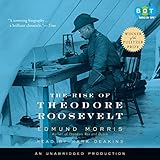
- Audible Audiobook
- Edmund Morris (Author) - Mark Deakins (Narrator)
- English (Publication Language)
- 06/22/2010 (Publication Date) - Random House Audio (Publisher)
Another critical theme is “The Burden of Legacy and the Shadow of Loss.” The profound influence of Theodore Roosevelt Sr., a man of immense moral character and social standing, looms large. Morris details how the elder Roosevelt’s ideals and expectations served as both inspiration and pressure for young Theodore. The untimely death of his father, and later, the simultaneous loss of both his mother and his first wife on the same day, are presented by Morris not merely as tragic events but as pivotal moments that forged Roosevelt’s resilience and intensified his drive. These experiences, Morris argues, instilled in Roosevelt a deep-seated urgency to live fully and to make a significant mark, perhaps as a way of honoring those he had lost and compensating for his perceived inability to protect them. This theme provides a crucial psychological underpinning for Roosevelt’s relentless energy and his almost compulsive need to achieve.
Morris also explores “The Performer and the Politician.” He subtly but persistently suggests that Roosevelt was acutely aware of his public image and actively cultivated it. From his early days, Roosevelt understood the power of narrative and spectacle. Morris points to Roosevelt’s penchant for dramatic pronouncements, his adoption of distinctive styles of dress, and his strategic use of the press as evidence of a man who was not only a politician but a performer on a grand stage. This perspective challenges a simplistic view of Roosevelt as purely an idealistic reformer; it acknowledges a shrewd manipulator of public perception, a quality that was essential for his rise in an era increasingly influenced by mass media. The reader is left to consider how much of Roosevelt’s persona was genuine conviction and how much was a carefully constructed act designed to achieve specific political ends.
Common Myths and Counter-Arguments
- Myth: Theodore Roosevelt was a natural leader whose political destiny was preordained.
- Why it matters: This myth simplifies Roosevelt’s complex journey and overlooks the immense effort and strategic maneuvering involved in his rise. It suggests an inherent quality rather than a developed skill set.
- Correction: Morris’s biography strongly refutes this by detailing Roosevelt’s early physical vulnerabilities and his relentless self-discipline. His leadership was not a birthright but a hard-won achievement, forged through overcoming personal limitations and navigating treacherous political waters. His early political career was marked by significant setbacks, such as his defeat in the New York mayoral election of 1886.
- Myth: Roosevelt’s reformist zeal was purely altruistic and unburdened by personal ambition.
- Why it matters: This presents an overly simplistic and idealistic view of a complex political figure. It ignores the inherent drive for power and recognition that often accompanies significant public service.
- Correction: While Roosevelt was undoubtedly driven by a genuine desire for public good, Morris’s work also highlights his profound ambition. His pursuit of reform was often intertwined with a desire for influence, recognition, and the exercise of power. His strategic maneuvering and his keen understanding of political advantage suggest a pragmatic approach to achieving his goals, which included personal advancement.
- Myth: Roosevelt’s persona as a “man of action” was entirely authentic and unmanufactured.
- Why it matters: This myth overlooks the performative aspect of his public life and the deliberate crafting of his image. It leads to an incomplete understanding of his political success.
- Correction: Morris provides ample evidence that Roosevelt was acutely aware of his public image and actively worked to shape it. His “strenuous life” philosophy, his adoption of rugged attire, and his dramatic pronouncements were not solely spontaneous expressions but also carefully cultivated elements of a powerful public persona designed to appeal to and inspire the American people.
Expert Tips for Reading Morris’s Biography
1. Embrace the Author’s Voice:
- Actionable Step: Read Morris’s prose actively, paying attention to his descriptive language, his asides, and his rhetorical questions.
- Common Mistake to Avoid: Skimming over Morris’s stylistic flourishes or treating them as mere embellishment. These are integral to his argument and his unique portrayal of Roosevelt. For example, Morris’s descriptions of Roosevelt’s physical presence are often imbued with a sense of awe, which colors the reader’s perception.
2. Contextualize Roosevelt’s Actions within the Gilded Age:
- Actionable Step: Before or during reading, refresh your understanding of the political and social conditions of the late 19th century, including issues like industrialization, immigration, and the corruption of political machines.
- Common Mistake to Avoid: Judging Roosevelt’s actions solely by modern standards without appreciating the specific challenges and norms of his era. Morris assumes a level of reader familiarity with this context. For instance, understanding the power of Tammany Hall is crucial to appreciating Roosevelt’s battles in New York.
3. Look for the “Contrarian” Thread:
- Actionable Step: Actively seek out instances where Morris challenges conventional wisdom or presents Roosevelt in a less flattering light, even amidst his admiration.
- Common Mistake to Avoid: Accepting Morris’s admiration as unconditional praise. His strength lies in his nuanced critique, revealing the complexities and potential contradictions in Roosevelt’s character. Morris often questions Roosevelt’s motivations or highlights his more ruthless political instincts, offering a balanced, if at times unsettling, perspective.
Quick Comparison
| Option | Best for | Pros | Watch out |
|---|---|---|---|
| The Rise of Theodore Roosevelt by Edmund Morris A Contrarians Examination | General use | Morris’s Authorial Voice and Interpretation: Edmund Morris is not a detached… | Mistake to Avoid: Glossing over the introduction as standard preamble. Morris… |
| What to Check First | General use | The Centrality of Self-Creation: The book’s core thesis revolves around Theod… | Mistake to Avoid: Dismissing Roosevelt’s physical ailments as minor inconveni… |
| Step-by-Step Plan for Engaging with The Rise of Theodore Roosevelt by Edmund Morris | General use | The Gilded Age Context: While Morris excels at bringing the era to life, a re… | Mistake to Avoid: Assuming a linear progression. Morris highlights moments of… |
| The Rise of Theodore Roosevelt by Edmund Morris A Thematic Deep Dive | General use | The Biography’s Scope: This volume concludes with Roosevelt’s nomination as V… | Mistake to Avoid: Viewing Roosevelt as an isolated figure. Morris demonstrate… |
Decision Rules
- If reliability is your top priority for The Rise of Theodore Roosevelt by Edmund Morris, choose the option with the strongest long-term track record and support.
- If value matters most, compare total ownership cost instead of headline price alone.
- If your use case is specific, prioritize fit-for-purpose features over generic ‘best overall’ claims.
FAQ
- Q: Is The Rise of Theodore Roosevelt by Edmund Morris suitable for someone new to Theodore Roosevelt?
- A: Yes, it serves as an excellent, albeit dense, introduction. Morris’s narrative style is engaging, and he provides substantial historical context. However, be prepared for a deeply interpretive rather than a purely factual account.
- Q: How does Morris’s portrayal of Roosevelt differ from other biographies?
- A: Morris’s distinctive contribution lies in his highly literary style and his willingness to inject his own authorial voice and critical perspective. He often emphasizes Roosevelt’s performative nature and his internal struggles more profoundly than more traditional biographies.
- Q: What is the most significant takeaway from The Rise of Theodore Roosevelt by Edmund Morris?
- A: The most significant takeaway is the understanding that Theodore Roosevelt was a product of relentless self-creation, driven by a profound need to overcome perceived weaknesses and leave an indelible mark on the world. Morris demonstrates this through meticulous detail and insightful analysis.
- Q: Does this book cover Roosevelt’s presidency?
- A: No, this volume focuses on Roosevelt’s life and career up to his nomination as Vice President in 1900. It lays the essential groundwork for his presidency but does not cover his time in the White House.
- Q: Is Edmund Morris’s style accessible to all readers?
- A: Morris’s prose is rich and evocative, which many readers find compelling. However, it can also be demanding, requiring close attention. Readers who prefer straightforward, unadorned historical accounts might find it challenging.
- Q: What makes this biography a “contrarian” view, as suggested?
- A: The contrarian aspect stems from Morris’s refusal to present Roosevelt as a simple hero. He deliberately highlights Roosevelt’s flaws, his ambition, and the constructed nature of his persona, challenging the more straightforwardly laudatory narratives that often surround him.
- Q: How important is the Gilded Age context to understanding this book?
- A: Extremely important. Morris expertly details the era, but a reader with some prior knowledge of its political corruption, social stratification,