Domagoj Kurmaić’s Mother Of Learning Story Analysis
Quick Answer
- Core Concept: Mother Of Learning by Domagoj Kurmaić is a lengthy web serial detailing a protagonist’s journey through a recurring time loop, focusing on meticulous knowledge acquisition and the psychological toll of extreme repetition.
- Reader Fit: Best suited for readers who value intricate world-building, deep character introspection, and a patient, analytical approach to narrative progression, particularly within the fantasy genre.
- Contrarian View: The series’ extreme length and deliberately slow initial pacing are significant barriers, potentially alienating readers seeking immediate plot momentum or concise storytelling, despite its detailed exploration of a time loop.
Who This Is For
- Readers who appreciate complex, logically constructed magic systems and enjoy seeing them deconstructed and mastered through iterative learning.
- Individuals interested in the psychological impact of extreme repetition, existential dilemmas, and the long-term effects of isolation on personal development.
What To Check First
- Pacing Tolerance: Assess your comfort level with narratives that emphasize incremental progress and detailed internal monologues over rapid plot advancement.
- Commitment Level: Recognize that Mother Of Learning is an exceptionally long work. Confirm you are prepared for a substantial reading commitment spanning potentially thousands of pages.
- Genre Expectations: If you prefer fast-paced action and immediate conflict resolution, the story’s focus on skill acquisition and strategic planning may not align with your preferences.
- Thematic Resonance: Consider if themes of repetition, determinism versus free will, and the nature of knowledge are subjects that engage you intellectually and emotionally.
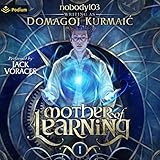
Mother of Learning Arc 1: Mother of Learning, Book 1
- Audible Audiobook
- nobody103 (Author) - Jack Voraces (Narrator)
- English (Publication Language)
- 12/21/2021 (Publication Date) - Podium Audio (Publisher)
Step-by-Step Plan: Analyzing Mother Of Learning by Domagoj Kurmaić
This section outlines a method for dissecting the narrative structure and thematic elements of Mother Of Learning.
1. Deconstruct the Loop’s Parameters:
- Action: Identify and document the precise rules governing the protagonist Zorian’s time loop.
- What to look for: Note the duration of the loop, the exact triggers for its reset, and any observed anomalies or constants within the repeating timeline.
- Mistake: Assuming the loop’s rules are static without observing Zorian’s efforts to test their boundaries or identify subtle, emergent properties.
2. Map Zorian’s Skill Acquisition Trajectory:
- Action: Track the specific skills Zorian learns and refines across successive loops.
- What to look for: Observe the progression of his magical abilities, his understanding of combat tactics, his social maneuvering, and his development in any other learned disciplines.
- Mistake: Focusing solely on the narrative events rather than the detailed, loop-by-loop accumulation of Zorian’s capabilities, which is central to his character arc.
3. Evaluate Thematic Integration:
- Action: Analyze how recurring themes such as determinism, the nature of consciousness, and the burden of knowledge are woven into the narrative.
- What to look for: Identify instances where Zorian grapples with these philosophical concepts and how his experiences within the loop shape his understanding and worldview.
- Mistake: Overlooking the philosophical underpinnings in favor of plot mechanics, thereby missing the story’s deeper intellectual and emotional resonance.
4. Assess the Evolution of Character Relationships:
- Action: Examine how Zorian’s interactions and relationships with other characters develop and change over numerous loops.
- What to look for: Observe the nuances in his connections, the impact of his repeated interactions, and how he navigates forming bonds when the ultimate outcome is reset.
- Mistake: Treating secondary characters as static elements rather than individuals whose own development, or lack thereof, influences Zorian and the narrative’s complexity.
5. Consider the Narrative’s Scope and Ambition:
- Action: Reflect on the immense scale of the story and the author’s management of intricate, long-term plotting.
- What to look for: Note the author’s ability to sustain a complex, multi-layered narrative that spans significant in-story time and considerable character growth across many cycles.
- Mistake: Underestimating the author’s long-term planning due to the slow burn of the initial chapters, potentially leading to premature dismissal of the story’s potential.
6. Analyze the Psychological Impact of Repetition:
- Action: Pay close attention to Zorian’s internal struggles and the emotional toll the endless repetition exacts upon him.
- What to look for: Identify moments of despair, ennui, existential dread, or the development of unique coping mechanisms.
- Mistake: Assuming Zorian remains unaffected by the loop, failing to recognize the author’s intent to portray the psychological realism of such an extreme situation.
Common Myths About Mother Of Learning
- Myth 1: The story is solely about the mechanics of a time loop.
- Correction: While the time loop is the central conceit, Mother Of Learning is equally, if not more, about Zorian’s personal development, his rigorous study of magic, and the philosophical questions arising from his unique predicament. The loop serves as the crucible for his growth.
- Evidence: The narrative dedicates extensive chapters to Zorian practicing spells, developing theories of magic, and reflecting on his moral choices, demonstrating a focus beyond just the temporal anomaly. For instance, Zorian’s deep dives into elemental magic theory and mana manipulation are not merely plot devices but explorations of his intellectual curiosity.
- Myth 2: The protagonist, Zorian, is a static character due to the loop.
- Correction: Zorian undergoes significant, albeit often internal, transformation. The loop forces him to confront his flaws, adapt his strategies, and grapple with the psychological weight of his situation, leading to profound character evolution.
- Evidence: Zorian’s initial anxieties and reactive behaviors evolve into calculated planning and a deeper understanding of himself and others, particularly evident in his attempts to build and maintain relationships across loops. His journey from a somewhat self-absorbed student to someone grappling with responsibility and the ethics of his foreknowledge showcases this evolution.
Mother Of Learning by Domagoj Kurmaić: Strengths and Limitations
- Strength: The narrative’s meticulous dissection of a magic system and its application within a time loop offers a unique intellectual engagement. The detailed, almost scientific, approach to spellcasting and power scaling is a significant draw for readers who appreciate intricate fantasy world-building. For example, Zorian’s methodical breakdown and reconstruction of basic spells, like the ‘Light Orb’ spell, demonstrate this detailed approach.
- Limitation: The story’s extreme length and deliberate, slow-burn pacing, especially in its early stages, can be a substantial barrier for readers who prefer more immediate plot resolution or concise narratives. This requires a significant investment of time and patience, a factor that distinguishes it from more rapidly paced fantasy series like Brandon Sanderson’s Mistborn trilogy, which offers a similarly intricate magic system but with a more accelerated plot.
Decision Rules
- If your primary constraint is time efficiency, Mother Of Learning by Domagoj Kurmaić is likely not a suitable choice due to its extensive length and slow initial pacing. Prioritize shorter, more plot-driven narratives like The Lies of Locke Lamora by Scott Lynch for immediate narrative payoff.
- If your goal is deep immersion and analytical engagement with a complex magic system and character study, then Mother Of Learning by Domagoj Kurmaić becomes a highly recommended option, provided you can accommodate its scale. Its detailed exploration of magical theory and Zorian’s psychological journey offers a depth rarely found in more conventional fantasy.
Quick Comparison
| Work | Best For | Strengths | Potential Drawbacks |
|---|---|---|---|
| Mother Of Learning by Domagoj Kurmaić | Readers seeking deep dives into magic systems and psychological endurance. | Meticulous magic system analysis, profound character introspection, exploration of existential themes. | Extreme length, very slow initial pacing, requires significant reader commitment. |
| Mistborn: The Final Empire | Readers desiring intricate magic systems with faster plot progression. | Innovative Allomancy system, strong character arcs, compelling plot with clear stakes and resolutions. | Less focus on the granular psychological impact of repetition compared to Mother Of Learning. |
| The Lies of Locke Lamora | Readers who enjoy witty dialogue, heist plots, and character-driven action. | Fast-paced plot, engaging characters, sharp dialogue, intricate world-building with a focus on intrigue. | Lacks the deep, iterative learning mechanic and existential exploration central to Mother Of Learning. |
FAQ
- Q: How does the protagonist’s learning process in Mother Of Learning differ from typical fantasy power progression?
- A: Zorian’s progression is not organic but meticulously engineered through repeated attempts within a time loop. He leverages foreknowledge and iterative practice to master skills with a precision and speed unattainable in a linear narrative, focusing on understanding fundamental principles rather than simply gaining power. For example, instead of stumbling upon a powerful spell, he might spend dozens of loops dissecting its theoretical underpinnings before casting it.
- Q: Is the psychological toll of the time loop in Mother Of Learning realistically portrayed?
- A: The narrative attempts a realistic portrayal by detailing Zorian’s struggles with ennui, existential dread, and the emotional difficulty of forming genuine connections when the world resets. While subjective, the author dedicates significant attention to these internal conflicts, depicting moments of profound despair and the development of coping mechanisms.
- Q: What is the most significant factor that might lead a reader to abandon Mother Of Learning?
- A: The sheer length and the slow, detailed progression of the initial arcs. Readers who expect rapid plot development or are averse to extensive descriptions