Discover Teaching To Transgress By bell hooks
Quick Answer
- Teaching To Transgress by bell hooks redefines education as a practice of freedom, emphasizing critical consciousness and liberation over traditional authoritarian models.
- It advocates for the classroom as a “beloved community” built on dialogue, mutual respect, and the integration of students’ lived experiences.
- Essential for educators committed to creating equitable, empowering, and transformative learning environments that challenge systemic oppression.
Who This Is For
- Educators across all levels (K-12 through higher education) seeking to cultivate deeper student engagement and critical thinking skills.
- Individuals interested in the intersection of social justice, pedagogy, and the philosophy of education, particularly as it relates to dismantling oppressive structures.
What to Check First
- Your current pedagogical assumptions: Do they prioritize knowledge transmission or the development of critical consciousness and self-awareness?
- Classroom power dynamics: Assess how authority and knowledge are distributed and whether students feel empowered to challenge established norms.
- Student voice and agency: Evaluate the extent to which students’ perspectives, experiences, and questions are actively solicited and integrated into the learning process.
- The emotional climate of your learning space: Consider whether it fosters an environment of trust and vulnerability necessary for open dialogue and intellectual risk-taking.
- Your definition of learning success: Determine if it focuses solely on content mastery or encompasses personal and intellectual transformation.
Step-by-Step Plan: Implementing Principles from Teaching To Transgress by bell hooks
This plan outlines actionable steps for integrating the core philosophy of Teaching To Transgress into your teaching practice.
1. Establish a “Beloved Community” Classroom:
- Action: Explicitly define and co-create classroom values that prioritize mutual respect, trust, and collective responsibility for learning with your students.
- What to look for: Evidence of students actively participating in setting norms, collaborative problem-solving, and a general atmosphere of collegiality and shared purpose.
- Mistake: Assuming students will automatically adopt these values without explicit discussion, consistent modeling, and deliberate reinforcement of desired behaviors.
2. Foster “The Will to Learn”:
- Action: Shift focus from solely delivering content to igniting students’ intrinsic motivation and cultivating a genuine desire for knowledge and understanding.
- What to look for: Increased student-led questioning, voluntary engagement in discussions, and students making meaningful connections between course material and their personal lives.
- Mistake: Over-reliance on external motivators like grades or rewards without nurturing the internal drive for intellectual exploration.
3. Practice “Engaged Pedagogy”:
- Action: Design learning experiences that actively involve students, challenge them critically, and validate their lived experiences as legitimate sources of knowledge.
- What to look for: Varied instructional methods (e.g., discussions, projects, experiential learning), integration of student-generated questions into lessons, and opportunities for students to connect course content to their realities.
- Mistake: Treating students as passive recipients of information rather than as active co-creators of meaning and knowledge.
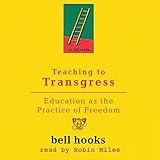
- Audible Audiobook
- bell hooks (Author) - Robin Miles (Narrator)
- English (Publication Language)
- 11/17/2017 (Publication Date) - Post Hypnotic Press Inc. (Publisher)
4. Cultivate “The Classroom as a Space of Radical Freedom”:
- Action: Create an environment where students feel safe to express diverse viewpoints and challenge ideas, including your own, without fear of penalty or judgment.
- What to look for: Respectful debate, students comfortable expressing dissent constructively, and your own willingness to acknowledge new perspectives or your limitations.
- Mistake: Equating “radical freedom” with a complete lack of structure, leading to unproductive chaos instead of generative critical dialogue.
5. Embrace “The Teacher as Intellectual”:
- Action: Position yourself as a lifelong learner committed to critical self-reflection about your teaching, biases, and evolving understanding of the subject matter and your students.
- What to look for: Demonstrating vulnerability by admitting what you don’t know, sharing your learning process, and engaging in ongoing professional development that challenges your assumptions.
- Mistake: Maintaining an unassailable, authoritarian stance that discourages student inquiry into your authority or knowledge base.
6. Promote “Critical Consciousness”:
- Action: Guide students to understand how social, political, and economic forces shape their realities and their educational experiences.
- What to look for: Students critically analyzing texts, media, and societal issues; discussions connecting classroom content to broader contexts; and evidence of students questioning dominant narratives.
- Mistake: Avoiding potentially sensitive topics or framing social issues in ways that reinforce, rather than challenge, existing power structures and inequalities.
Teaching To Transgress by bell hooks: Core Principles and Considerations
bell hooks’ Teaching To Transgress: Education as the Practice of Freedom is a seminal work that fundamentally reorients the purpose of education. hooks argues that traditional schooling often functions as a mechanism for social control rather than liberation, and she proposes an alternative: an “engaged pedagogy” that fosters critical consciousness and empowers students to transform their world. This approach moves away from authoritarian models where the teacher is the sole possessor of knowledge, towards a collaborative environment where learning is a shared, dialogical process.
A central concept is the classroom as a “beloved community,” a space where trust, care, and intellectual rigor can coexist. This requires cultivating “radical freedom,” which hooks clarifies is not an absence of boundaries but an environment where students feel safe to express themselves and challenge ideas. Learning, for hooks, is deeply intertwined with emotion, and acknowledging and integrating affective dimensions is crucial for genuine transformation. The teacher’s role is reimagined as an intellectual and a learner, committed to critical self-reflection and the cultivation of critical consciousness in students.
However, the radical nature of hooks’ vision can be misinterpreted, leading to certain common misconceptions.
Common Myths About “Teaching To Transgress”
- Myth 1: Engaged pedagogy means abandoning all structure and allowing complete student anarchy.
- Why it matters: This misunderstanding can lead to unproductive classroom environments that undermine educational goals. hooks’ vision of “radical freedom” is about empowering students to engage critically within a framework of mutual respect and shared responsibility, not about the absence of necessary guidelines.
- Fix: Recognize that “radical freedom” is about fostering intellectual and emotional liberation through empowered participation, not about eliminating structure. Structure is essential to support, not suppress, meaningful dialogue and inquiry.
- Myth 2: Teaching To Transgress by bell hooks is only relevant for higher education or social justice-focused disciplines.
- Why it matters: This perception limits the broad applicability of hooks’ clear insights. The principles of fostering critical thinking, student agency, and building community are universally valuable across all educational settings and subject areas, from elementary classrooms to vocational training.
- Fix: Apply hooks’ core concepts—prioritizing student voice, encouraging critical inquiry, and creating supportive learning environments—to any educational context, adapting them to the specific age group and subject matter.
Expert Tips for Implementing Transformative Education
Here are practical insights for educators aiming to embody the spirit of Teaching To Transgress.
1. Tip: Clearly define and collaboratively establish classroom values.
- Actionable Step: Dedicate initial class time to a discussion about what respect, participation, and intellectual curiosity mean in your specific learning environment. Co-create a list of shared principles and display them prominently.
- Common Mistake to Avoid: Assuming students understand abstract concepts like “respect” without concrete examples or a shared definition, leading to inconsistent application and misunderstandings.
2. Tip: Integrate student lived experiences as a primary source of knowledge.
- Actionable Step: Before presenting formal content on a new topic, ask students to share their prior knowledge, personal connections, or initial questions related to it. Use these contributions as a foundation for your instruction and discussion.
- Common Mistake to Avoid: Dismissing or overlooking student contributions that deviate from the planned curriculum, which can signal that their experiences are less valued than the prescribed material.
3. Tip: Practice intellectual humility and vulnerability.
- Actionable Step: When a student asks a question you cannot immediately answer, openly admit it and propose a collaborative approach to finding the answer. For example, “That’s an excellent question. I don’t have that information readily available, but let’s explore it together. We could research X, Y, and Z.”
- Common Mistake to Avoid: Feeling compelled to always have the “correct” answer, which can create a barrier to genuine dialogue and discourage students from asking challenging questions.
Teaching To Transgress by bell hooks: A Comparative Perspective
bell hooks’ Teaching To Transgress distinguishes itself through its unwavering focus on liberation and its incisive critique of power dynamics within education. Compared to Paulo Freire’s Pedagogy of the Oppressed, which primarily addresses the liberation of the oppressed from systemic subjugation, hooks extends this concept to the daily classroom experience, emphasizing the teacher’s role in cultivating a “beloved community” where both teacher and student can achieve transformative growth. Her work is less about prescribing a specific curriculum and more about fostering an underlying philosophy and practice that can reshape any learning space. While John Dewey’s Democracy and Education also champions experiential learning and democratic ideals in schooling, hooks’ approach is more explicitly rooted in confronting the psychological and emotional barriers to learning that often stem from social injustice and power imbalances.
| Aspect | Value | Details | Caveats |
|---|---|---|---|
| Core Philosophy | Transformative Education | Focuses on liberation, critical consciousness, and the classroom as a “beloved community.” | Requires a significant shift from traditional, authoritarian teaching models. |
| Pedagogical Approach | Engaged Pedagogy | Emphasizes dialogue, mutual respect, and integrating student experiences. | Can be challenging to implement without careful planning and consistent effort. |
| Teacher’s Role | Intellectual and Learner | Positions the teacher as a facilitator and co-learner, committed to critical self-reflection. | Demands vulnerability and a willingness to challenge one’s own assumptions |
Decision Rules
- If reliability is your top priority for Teaching To Transgress by bell hooks, choose the option with the strongest long-term track record and support.
- If value matters most, compare total ownership cost instead of headline price alone.
- If your use case is specific, prioritize fit-for-purpose features over generic ‘best overall’ claims.