Daniel Defoe’s Moll Flanders: A Life of Adventure
Daniel Defoe’s Moll Flanders offers a compelling, first-person narrative of a woman’s determined journey through the social and economic complexities of 18th-century England. Born into destitution, Moll navigates a world rife with crime, precarious marriages, forced emigration, and eventual declarations of penitence. The novel stands as a significant work in English literature, providing a starkly realistic depiction of societal constraints, the desperation of poverty, and the multifaceted nature of female agency.
Who this is for
- Readers exploring early English novels: Moll Flanders is a foundational text in the picaresque tradition and essential for understanding the novel’s development, its social commentary, and its engagement with realism.
- Those who value character-driven narratives: Moll’s unvarnished, often morally ambiguous, voice immerses readers in her journey, establishing her as a complex and memorable protagonist whose struggles resonate beyond her historical setting.
What to check first
- Historical Context: A grasp of the social hierarchy, economic conditions, and limited opportunities for women in 17th and 18th-century England is crucial for appreciating Moll’s choices and the societal pressures she faced.
- Narrative Reliability: Moll’s account is a confession. Recognize that it is filtered through her perspective, potentially biased, and shaped by her desire to justify her actions and seek absolution.
- Moral Ambiguity: The novel deliberately blurs ethical lines. Moll’s actions, though often illicit, are presented as survival mechanisms, prompting readers to question societal definitions of virtue and vice.
- Themes of Social Mobility: Observe Moll’s persistent efforts to ascend the social ladder through unconventional means, highlighting the rigid class structures and restricted avenues for women’s advancement.
Step-by-step plan for understanding Moll Flanders
1. Examine Moll’s origins: Action: Read the initial chapters detailing her birth in a workhouse and subsequent upbringing. What to look for: The stark realities of poverty, the absence of conventional family structures, and early indicators of her resourcefulness and desire for a better life. Mistake: Underestimating the impact of her impoverished beginnings; these experiences form the foundation of her survival instincts and future actions.
2. Trace her marital and romantic entanglements: Action: Follow Moll’s progression through multiple marriages and relationships. What to look for: The economic motivations behind her choices and how societal expectations and legal frameworks dictated women’s financial security through marriage. Mistake: Judging her decisions solely by modern romantic ideals; her marriages are often strategic alliances for survival and social advancement.
3. Analyze her periods of criminality: Action: Examine instances where Moll resorts to theft and deception. What to look for: The desperation and lack of viable alternatives that drive her criminal behavior, and her internal justifications for these actions. Mistake: Viewing her criminality as gratuitous or sensational; it is presented as a direct consequence of her societal and economic marginalization.
4. Consider her transportation to America: Action: Read the sections describing her banishment and experiences in the colonies. What to look for: The consequences of her past actions, the challenges of starting anew in a different environment, and the continuation of societal hierarchies. Mistake: Assuming America offers a simple, unburdened fresh start; the novel demonstrates that personal history and societal patterns can follow individuals.
5. Evaluate her claims of repentance: Action: Pay attention to Moll’s reflections and declarations of reform later in her life. What to look for: The sincerity and nature of her repentance; is it genuine remorse, a desire for peace, or a narrative strategy to present herself favorably? Mistake: Accepting her pronouncements of reform at face value without critically assessing her ongoing narrative self-interest.
6. Examine Defoe’s narrative techniques: Action: Note the consistent first-person narration and its effect on reader perception and empathy. What to look for: How Moll’s voice shapes the story, influences judgments, and creates a sense of intimacy and authenticity, even while presenting a potentially biased account. Mistake: Forgetting that this is a fictionalized confession designed to engage the reader, rather than an objective historical record.
Common Mistakes When Reading Moll Flanders
- Mistake: Judging Moll solely by contemporary ethical standards.
- Why it matters: This approach fails to account for the severe economic and social limitations faced by women in the 18th century, where survival often necessitated morally compromising actions.
- Fix: Approach Moll’s decisions with an informed understanding of the historical context and the restricted options available to women of her class and time.
- Mistake: Treating Moll’s narrative as an objective, factual account.
- Why it matters: As a first-person confession, the narrative is inherently subjective. Moll is recounting her life story to a specific audience, likely with the intent to justify her past and present herself in a favorable light.
- Fix: Read critically, questioning Moll’s motivations, acknowledging the potential for self-serving bias, and considering what she chooses to reveal or conceal.
- Mistake: Focusing exclusively on the sensational or scandalous aspects of her life.
- Why it matters: While her adventures—theft, prostitution, multiple marriages—are dramatic, the novel’s true depth lies in its exploration of broader themes like social mobility, the nature of sin and redemption, and the economic realities of the era.
- Fix: Pay attention to Defoe’s subtle social commentary, Moll’s internal reflections, and the broader societal structures that shape her experiences.
- Mistake: Underestimating the pervasive influence of economic factors.
- Why it matters: Moll’s life is a continuous struggle for financial security and stability. Economic desperation is a primary driver behind many of her choices, relationships, and compromises.
- Fix: Recognize how financial precarity shapes her relationships, her career paths, and her moral decision-making throughout the narrative.
For a deep dive into Moll’s compelling journey, consider picking up a copy of Daniel Defoe’s classic novel.
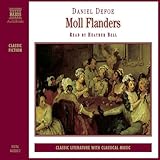
- Audible Audiobook
- Daniel Defoe (Author) - Heathre Bell (Narrator)
- English (Publication Language)
- 10/26/2000 (Publication Date) - Naxos AudioBooks (Publisher)
Moll Flanders by Daniel Defoe: Themes and Literary Significance
Daniel Defoe’s Moll Flanders transcends a mere chronicle of a woman’s tumultuous life; it serves as a potent exploration of societal structures, individual agency, and the fluid boundaries of morality. The novel’s enduring impact stems from its unflinching realism and its portrayal of a woman determined to forge her own destiny in a world that offered few legitimate paths to success for those of her station.
A central theme is the struggle for social and economic survival. Moll’s existence is a constant negotiation of her circumstances, driven by an acute need for security and comfort. Her repeated marriages, which might appear opportunistic, are presented within the narrative as necessary transactions in a society where women’s financial independence was severely limited. Defoe uses Moll’s journey to critique the rigid social hierarchy and the restricted opportunities available to women, implicitly arguing that societal conditions can compel individuals into morally compromising actions simply to survive.
Another critical element is the ambiguity of morality. Moll is far from a conventional virtuous heroine. She engages in theft, deception, and prostitution, yet Defoe frames these actions with a degree of narrative sympathy, presenting them as responses to dire necessity. This approach compels readers to confront complex questions about sin, repentance, and the societal conditions that influence individual behavior. The novel challenges simplistic dichotomies of good and evil, suggesting that morality is often a contextual concept, heavily influenced by circumstance.
Expert Tips for Engaging with Moll Flanders
- Tip: Analyze Moll’s justifications for her actions.
- Actionable Step: As you read, actively note down Moll’s explanations for her choices, especially her criminal acts and morally questionable decisions. Consider whether these justifications are convincing or appear to be self-serving.
- Common Mistake to Avoid: Accepting her rationalizations without critical examination; her narrative is a form of self-rehabilitation, designed to mitigate her perceived sins.
- Tip: Track the interplay between “fortune” and “Providence.”
- Actionable Step: Observe instances where Moll attributes events to luck, chance, or divine intervention. Analyze how these attributions align with or contradict her own active choices and agency in shaping her destiny.
- Common Mistake to Avoid: Perceiving Moll as solely a victim of fate; her proactive decisions and resourcefulness play a significant role in her life’s trajectory, even when she invokes external forces.
- Tip: Compare Moll’s narrative to other contemporary accounts of women’s lives.
- Actionable Step: Research historical accounts or other literary works depicting women in similar social strata during the 18th century. Consider how Moll’s experiences and agency compare to those of real or fictional women of her time.
- Common Mistake to Avoid: Isolating Moll’s story as unique; understanding her within the broader social context reveals the systemic challenges and opportunities (or lack thereof) for women of her era.
BLOCKQUOTE_0
This quote encapsulates Moll’s pragmatic approach to morality. Her actions are often dictated not by an intrinsic desire for goodness, but by a calculated avoidance of punishment and negative repercussions. This focus on practical consequences over abstract principles is characteristic of Defoe’s realistic portrayal of human motivation.
How this list was curated
This guide was curated with the following criteria to ensure a practical and insightful reading experience of Moll Flanders by Daniel Defoe:
- Thematic Depth: Prioritizing sections that explore the novel’s core themes of social mobility, morality, and survival, moving beyond plot summary.
- Reader Contextualization: Ensuring that advice and explanations are grounded in the historical and literary context of 18th-century England, providing necessary background for comprehension.
- Critical Engagement: Encouraging a reader’s active participation by highlighting potential narrative biases and prompting critical analysis of Moll’s character and motivations.
- Actionable Advice: Providing clear, step-by-step guidance and practical tips that aid the reader in navigating and understanding the complexities of the text.
- Nuanced Judgment: Offering insights into the novel’s literary significance and complexities, avoiding generic praise and focusing on concrete takeaways.
Moll Flanders by Daniel Defoe: A Reader’s Segmentation
- For the Beginner Reader: If you are new to Defoe or early English novels, begin with a focus on Moll’s immediate experiences and her compelling narrative voice. The initial chapters detailing her poverty and her early marriages provide accessible entry points into her world and motivations.
- For the Literary Analyst: For those interested in literary theory and historical context, delve into the novel’s structure, Defoe’s narrative techniques, and its place within the development of realism and the picaresque novel. Analyze the themes of capitalism, gender, and the social contract.
- For the Social Historian: If your interest lies in the historical period, use Moll Flanders as a primary source for understanding 18th-century London’s social fabric, the realities of poverty, crime, the justice system, and the limited roles available to women.
Surprising Pick: The Colonial Interlude
While Moll’s adventures in London are often the most discussed aspect of the novel, her period of transportation and subsequent life in the American colonies offers a unique and often under-appreciated dimension.
- Why it’s surprising: Many readers focus on her urban exploits, overlooking how this transatlantic shift provides a distinct perspective on themes of exile, reinvention, and the complex relationship between Britain and its colonies. It presents a different form of “adventure” and a crucial opportunity for Moll to confront her past and adapt to a new environment, challenging her assumptions and resilience in ways distinct from her London experiences.
Quick Comparison
| Aspect | Focus | Strengths | Limitations |
|---|---|---|---|
| <strong>Who this is for</strong> | Reader Type | Identifies specific audience segments for targeted engagement. | May not capture the full breadth of appeal for all readers. |
| <strong>What to check first</strong> | Preparatory Steps | Provides essential context for deeper understanding. | Relies on reader initiative to follow up on suggestions. |
| <strong>Step-by-step plan</strong> | Reading Strategy | Offers a structured approach to analyzing the narrative arc. | Might feel overly prescriptive for some reading styles. |
| <strong>Common Mistakes</strong> | Reader Pitfalls | Highlights common interpretive errors to avoid. | Focuses on potential negatives rather than positive reading strategies. |
Decision Rules
- If your primary goal is to understand the historical context of Moll Flanders by Daniel Defoe, prioritize the sections on historical context and social themes.
- If you are interested in analyzing narrative techniques and Defoe’s style, focus on the sections discussing narrative voice and literary significance.
- If you seek a pragmatic approach to reading the novel, follow the step-by-step plan and pay close attention to the common mistakes section.
FAQ
- Q: Is Moll Flanders a factual autobiography?
- A: No, Moll Flanders is a work of fiction by Daniel Defoe. While it employs a realistic narrative style and reflects the social conditions of its time, it is not a literal account of a real person’s life.
- Q: What is the central message or theme of Moll Flanders?
- A: The novel primarily explores themes of survival, social mobility, the impact of poverty on morality, and the complex nature of female agency within restrictive societal structures. It questions traditional notions of virtue and vice in the face of economic necessity.
- Q: Why does Moll engage in so many marriages and illicit relationships?
- A: Moll’s relationships are largely driven by her persistent need for financial security and social standing. In the 18th century, marriage was often the primary means for women to achieve economic stability and upward mobility, leading Moll to enter into multiple unions strategically.
- Q: How should I interpret Moll’s repentance at the end of the novel?
- A: Moll’s repentance is often interpreted as complex and potentially self-serving. While she claims to have found faith and reformed, readers are encouraged to critically assess the sincerity of her claims, considering her lifelong pragmatism and the narrative’s overall tone.
- Q: Is Moll Flanders considered an early feminist work?
- A: Moll Flanders can be viewed as proto-feminist due to its strong, active female protagonist who navigates a patriarchal society with considerable agency, albeit through unconventional and morally ambiguous means. However, it also reflects the limitations and societal expectations placed upon women of the period.
Structured Pick Cards
Expert Tips for Engaging with Moll Flanders
- Best for: readers who want practical takeaways and clear progression.
- Skip if: you need only advanced theory with little implementation guidance.
- Trade-off: stronger depth can mean a slower pace in some chapters.
**Readers exploring early English novels
- Best for: readers who want practical takeaways and clear progression.
- Skip if: you need only advanced theory with little implementation guidance.
- Trade-off: stronger depth can mean a slower pace in some chapters.
**Those who value character-driven narratives
- Best for: readers who want practical takeaways and clear progression.
- Skip if: you need only advanced theory with little implementation guidance.
- Trade-off: stronger depth can mean a slower pace in some chapters.
By Reader Level
- Beginner: start with one fundamentals pick and one habit-building pick.
- Intermediate: prioritize books with frameworks you can apply weekly.
- Advanced: choose deeper titles focused on systems and decision quality.