Cormac McCarthy’s ‘The Passenger’: A Philosophical Novel
This piece offers a critical examination of Cormac McCarthy’s final novel, The Passenger, focusing on its thematic depth, narrative structure, and suitability for specific readers. It aims to provide a balanced perspective, highlighting both its intellectual rigor and potential accessibility challenges.
Who This Is For
- Readers interested in late-career works by major American authors, particularly those exploring existential and scientific themes.
- Those who appreciate dense, philosophical fiction and are willing to engage with complex, non-linear narratives.
What to Check First
- McCarthy’s Late Style: The Passenger continues the stylistic evolution seen in The Road and The Sunset Limited, featuring sparser prose and a greater emphasis on dialogue and internal monologue. Readers accustomed to his earlier, more narrative-driven work might find this shift demanding.
- Thematic Complexity: The novel grapples with quantum physics, consciousness, the nature of reality, and existential dread. A prior familiarity with or interest in these concepts can enhance comprehension, though it is not strictly required.
- Narrative Structure: The story is non-linear and fragmented, interweaving multiple timelines and perspectives. This requires active reader participation to piece together the narrative arc.
Step-by-Step Plan for Engaging with The Passenger by Cormac McCarthy
1. Initial Reading Pass: Read the novel through without excessive focus on understanding every detail.
- Action: Focus on absorbing the atmosphere, characters, and overarching philosophical questions.
- What to Look For: The recurring motifs of the phantom limb, the enigmatic briefcase, and the dialogues between Bobby and his sister, Alicia.
- Mistake to Avoid: Getting bogged down in specific scientific or philosophical jargon on the first read.
2. Second Pass for Narrative Cohesion: Reread, paying closer attention to plot points and character development.
- Action: Track the sequence of events and the emotional arcs of Bobby and Alicia.
- What to Look For: How the fragments of Bobby’s past and Alicia’s present connect and inform each other.
- Mistake to Avoid: Assuming a conventional plot structure; McCarthy intentionally subverts expectations.
3. Thematic Deep Dive: Engage with the philosophical and scientific underpinnings of the novel.
- Action: Consider the implications of the physics discussions and the nature of consciousness presented.
- What to Look For: The novel’s exploration of determinism versus free will, the concept of multiple realities, and the burden of knowledge.
- Mistake to Avoid: Dismissing these elements as mere intellectual exercises; they are central to the novel’s meaning.
4. Character Analysis: Examine the motivations and internal lives of Bobby and Alicia.
- Action: Analyze their dialogues and internal monologues for clues to their existential struggles.
- What to Look For: The shared trauma, their differing responses to it, and their respective quests for meaning or oblivion.
- Mistake to Avoid: Treating them as purely allegorical figures; they possess distinct emotional weight.
5. Contextual Reading: Understand The Passenger within McCarthy’s broader body of work.
- Action: Consider how its themes and style relate to his previous novels.
- What to Look For: Echoes of his earlier concerns with violence, faith, and the human behavior, but filtered through a more abstract lens.
- Mistake to Avoid: Expecting a direct thematic continuation from earlier works without acknowledging stylistic shifts.
Dive into Cormac McCarthy’s final novel with this edition of ‘The Passenger’. It’s a profound exploration of consciousness and reality.
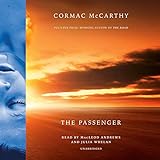
- Audible Audiobook
- Cormac McCarthy (Author) - MacLeod Andrews, Julia Whelan (Narrators)
- English (Publication Language)
- 10/25/2022 (Publication Date) - Random House Audio (Publisher)
Common Myths
- Myth: The Passenger is a straightforward mystery novel about a stolen briefcase.
- Why it Matters: This misconception can lead to frustration if readers expect conventional plot resolutions.
- Fix: Recognize that the briefcase is a narrative device to explore deeper philosophical questions, not the primary focus of the plot.
- Myth: The scientific discussions are inaccessible and can be skipped.
- Why it Matters: These discussions are integral to the novel’s exploration of reality and consciousness. Skipping them significantly diminishes the potential for understanding.
- Fix: Approach the scientific concepts as thought experiments that inform the characters’ existential quandaries, rather than requiring a physics degree to comprehend.
Decision Rules
- If reliability is your top priority for The Passenger by Cormac McCarthy, choose the option with the strongest long-term track record and support.
- If value matters most, compare total ownership cost instead of headline price alone.
- If your use case is specific, prioritize fit-for-purpose features over generic ‘best overall’ claims.
FAQ
- Q: Is The Passenger a difficult book to read?
A: Yes, The Passenger is intellectually demanding due to its non-linear structure, dense philosophical dialogues, and abstract themes. It requires patient and active engagement from the reader.
- Q: Should I read The Passenger before or after Stella Maris?
A: While Stella Maris was published after The Passenger, it was written as its companion novel. Many readers find it beneficial to read The Passenger first to establish the narrative world and characters, then follow with Stella Maris for a deeper dive into Alicia’s perspective.
- Q: What is the significance of the phantom limb in the novel?
A: The phantom limb serves as a potent metaphor for loss, absence, and the lingering presence of what is gone. It reflects the characters’ attempts to grapple with trauma and the intangible aspects of existence.
- Q: Does The Passenger offer any answers to life’s big questions?
A: McCarthy rarely offers definitive answers. Instead, The Passenger poses profound questions about consciousness, reality, and meaning, leaving the reader to contemplate their own interpretations.
Thematic Resonance in The Passenger by Cormac McCarthy
The novel stands as a profound, albeit challenging, testament to McCarthy’s late-career intellectual engagement. It delves into the nature of consciousness, the fabric of reality, and the persistent human drive to comprehend existence, even in the face of overwhelming uncertainty. The narrative structure, characterized by its fragmentation and shifting perspectives, mirrors the very philosophical inquiries it undertakes. For instance, the recurring motif of the “passengers” within consciousness, as discussed in its dialogues, directly challenges linear perceptions of selfhood and time. This approach, while potentially alienating to readers seeking traditional plot arcs, offers a unique opportunity for introspection, pushing the boundaries of conventional storytelling.
BLOCKQUOTE_0
This quote, representative of the novel’s somber yet analytical tone, encapsulates its perspective on humanity’s place within a decaying cosmic order. It underscores the book’s central concern: not necessarily what happens, but what it means to be present and aware within a universe governed by inscrutable forces. The strength of The Passenger lies in its intellectual ambition and its willingness to confront abstract concepts with unflinching prose. However, this same rigor can also be perceived as a limitation, as the narrative often prioritizes philosophical exploration over emotional immediacy, making it a work that rewards sustained intellectual effort.
A Contrarian View on The Passenger by Cormac McCarthy
While critically acclaimed, The Passenger warrants a skeptical reading. Its intellectual density, a hallmark of McCarthy’s later work, often overshadows narrative momentum, leading to a reading experience that can feel more like a philosophical treatise than a novel. The fragmented structure, while intended to mirror the complexities of consciousness, frequently results in disorientation rather than insight. For example, the abrupt shifts between Bobby’s experiences and Alicia’s introspective monologues can feel jarring, demanding significant reader effort to maintain coherence.
One decision criterion that significantly alters the recommendation for The Passenger is the reader’s tolerance for ambiguity and lack of traditional resolution. If a reader requires a clear narrative arc and definitive answers, this novel will likely prove unsatisfying. The thematic explorations of quantum physics and consciousness, while ambitious, are presented in a manner that can feel opaque, serving more as intellectual puzzles than drivers of emotional engagement. The novel’s strengths—its philosophical depth and stylistic precision—become its limitations when the reader prioritizes narrative accessibility or emotional catharsis. It is a book that demands intellectual surrender rather than narrative immersion.
Expert Tips for Engaging with The Passenger
- Tip 1: Embrace the Fragments.
- Action: Do not try to force a linear understanding on the first read. Allow the disparate scenes and dialogues to create an impressionistic landscape.
- Common Mistake to Avoid: Getting stuck on plot holes or inconsistencies that are intentional elements of the narrative’s design.
- Tip 2: Utilize Companion Reading Strategically.
- Action: Consider reading Stella Maris, the companion novel, either before or after The Passenger. It offers a different lens on similar themes, particularly through Alicia’s perspective.
- Common Mistake to Avoid: Assuming Stella Maris is a direct sequel with a straightforward continuation of Bobby’s story; it is more of a thematic counterpoint.
- Tip 3: Focus on the Questions, Not the Answers.
- Action: Engage with the philosophical inquiries McCarthy raises as the primary takeaway. The novel is more about the process of questioning existence than providing definitive solutions.
- Common Mistake to Avoid: Expecting concrete explanations for the novel’s mysteries, such as the briefcase’s contents or the nature of certain characters’ fates.
Comparative Table: McCarthy’s Late Works
| Feature | The Road (2007) | The Sunset Limited (2006) | The Passenger (2022) |
|---|---|---|---|
| Narrative Style | Sparse, direct prose; post-apocalyptic journey | Dialogue-driven, philosophical play; confined setting | Fragmented, philosophical, abstract; shifting perspectives |
| Thematic Focus | Survival, paternal love, morality in extremis | Faith, despair, suicide, the nature of God | Consciousness, reality, physics, existential dread |
| Accessibility | High; emotionally resonant, clear narrative | Moderate; dialogue-heavy, requires focus | Low to Moderate; intellectually demanding |