Claire Evans’ Broad Band: A Look At Women In Tech
Quick Answer
- Broad Band by Claire Evans offers a meticulously researched counter-narrative to the traditional, male-centric history of computing, highlighting the foundational and often erased roles of women.
- The book argues that women’s declining presence in tech is not due to a lack of aptitude but a result of systemic shifts in the industry’s professionalization and valuation of technical roles.
- This work is essential for understanding the historical roots of gender inequality in technology but provides limited direct advice for contemporary career navigation.
Who This Is For
- Readers interested in a critical, historically grounded examination of gender dynamics within technological fields.
- Individuals seeking to challenge dominant narratives of innovation and understand the social forces that shape who is recognized in STEM.
What to Check First
- Historical Scope: Note the specific periods of computing history Evans covers, from early mechanical devices to the digital age.
- Author’s Argument: Identify the central thesis regarding how and why women’s roles in computing evolved or diminished.
- Evidence Base: Assess the reliance on primary sources, historical documents, and academic research to support claims.
- Contemporary Relevance: Determine how the historical analysis is connected to present-day discussions on diversity and inclusion in tech.
Step-by-Step Plan for Engaging with Broad Band by Claire Evans
This structured approach encourages a critical engagement with Broad Band by Claire Evans, focusing on identifying its core arguments and potential limitations.
For a deep dive into the historical context of women in computing, Broad Band by Claire Evans is an indispensable read. It meticulously uncovers the foundational roles women played and how systemic shifts led to their diminished presence.
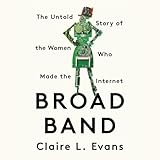
- Audible Audiobook
- Claire L. Evans (Author) - Claire L. Evans (Narrator)
- English (Publication Language)
- 03/06/2018 (Publication Date) - Penguin Audio (Publisher)
1. Map the Historical Trajectory: Begin by understanding the chronological arc of computing history as presented.
- Action: Note the key periods covered, such as the wartime computational efforts, the mainframe era, and the rise of personal computing.
- What to Look For: The author’s framing of how women’s roles evolved or diminished across these distinct technological phases.
- Mistake: Assuming a uniform experience for women throughout tech history; the nature of their participation and the barriers they faced changed significantly over time.
2. Deconstruct the “Feminization” of Early Computing: Analyze how tasks initially deemed clerical or supportive, and thus associated with women, were later reclassified.
- Action: Pay close attention to how Evans describes early programming, often performed by women, and its subsequent redefinition as a higher-status “engineering” role.
- What to Look For: Evidence of how the professionalization of computing led to a narrowing of opportunities for women.
- Mistake: Underestimating the impact of these reclassifications; they were crucial in shifting the gender demographics of the field.
3. Identify Patterns of Exclusion and Erasure: Track instances where women’s contributions were minimized, overlooked, or attributed elsewhere.
- Action: Note specific examples of women whose work was foundational but not widely recognized in mainstream histories.
- What to Look For: The mechanisms of erasure, such as the shift from collaborative team efforts to individualistic “inventor” narratives.
- Mistake: Accepting the dominant historical narrative at face value without actively seeking out the counter-evidence presented in the book.
4. Examine the “Failure Mode”: The Illusion of Progress: Recognize that the book often demonstrates how perceived progress for women in tech was frequently followed by regression or the creation of new barriers.
- Action: Critically assess sections that describe periods of greater female participation, and then analyze the subsequent shifts that led to their decline.
- What to Look For: The cyclical nature of inclusion and exclusion, driven by industry trends and cultural biases.
- Mistake: Believing that once women gained a foothold in a particular area, their presence was secure; the book highlights the ongoing struggle against systemic forces.
5. Evaluate the Role of Cultural Context: Understand how broader societal expectations and gender norms influenced women’s access to and progression within the tech industry.
- Action: Note how Evans connects technological developments to prevailing cultural attitudes about women’s capabilities and roles.
- What to Look For: Discussions about the impact of feminism, but also the backlash and reinforcement of traditional gender roles.
- Mistake: Separating the history of technology from the social history of the time; they are intrinsically linked.
6. Assess the Book’s Modern Relevance: Consider what lessons from Broad Band by Claire Evans can be applied to understanding current challenges in tech diversity.
- Action: Reflect on how historical patterns of exclusion and the redefinition of roles might manifest in contemporary workplace dynamics and hiring practices.
- What to Look For: Parallels between past systemic issues and present-day diversity metrics and discussions.
- Mistake: Dismissing historical context as irrelevant to current problems; understanding the roots is crucial for effective solutions.
7. Consider the Author’s Analytical Framework: Recognize that Evans’s work is an interpretation of history, not a neutral compilation of facts.
- Action: Note the recurring themes and the author’s emphasis on systemic analysis.
- What to Look For: The balance between individual stories and the broader social and economic forces at play.
- Mistake: Reading the book as a definitive, objective truth rather than a carefully argued historical thesis.
Broad Band by Claire Evans: Unpacking Gendered Tech Histories
This section critically examines the central themes within Broad Band by Claire Evans, focusing on the book’s strengths in revealing historical patterns of gender in computing.
Evans systematically deconstructs the myth of a perpetually male-dominated technological landscape. She meticulously details how women were integral to the very foundations of computing, from the code-breaking efforts of World War II to the development of early programming languages. For instance, the ENIAC programmers, a group of highly skilled women who performed complex calculations, are presented not just as operators but as essential problem-solvers. The book’s strength lies in its consistent demonstration that when technical roles were seen as akin to clerical or administrative work, women were often at the forefront. This narrative challenges the simplistic idea that women were never “interested” in technology, suggesting instead that their participation was contingent on how the field was defined and valued.
A key counterpoint to a straightforward celebration of these pioneers is the analysis of how their roles and contributions were later marginalized. As computing evolved and became a more lucrative and prestigious field, the pathways for women to advance became significantly narrower. Evans illustrates how programming, once a task performed by women, was redefined as a male-dominated engineering discipline, effectively pushing women out. This pattern serves as a critical lens through which to view the present-day gender gap in tech. The limitation for some readers might be that the book’s focus remains historical; it provides deep context but offers less in terms of direct, prescriptive advice for navigating contemporary tech environments.
Common Myths About Women in Computing History
- Myth: Women were always a minor presence in the history of computing.
- Correction: Evans’s work, along with other historical accounts, shows that in the early decades of computing, particularly during wartime and the initial development of programming, women constituted a significant portion of the workforce performing complex computational tasks. Their presence was substantial before the field became highly professionalized and gendered.
- Myth: The decline of women in tech is due to a lack of innate aptitude or interest.
- Correction: Broad Band by Claire Evans argues that systemic factors, rather than individual lack of interest or ability, led to the decrease in women’s participation. This includes the professionalization of computing, the shift in how programming was valued, and the creation of unwelcoming or exclusionary environments.
- Myth: Early female computer pioneers primarily performed simple, repetitive tasks.
- Correction: The book highlights that women like the ENIAC programmers and Grace Hopper were engaged in highly complex intellectual work, including debugging, system design, and the development of fundamental programming concepts and languages. Their contributions were technical and innovative.
Expert Tips for Analyzing Broad Band by Claire Evans
- Tip: Focus on the redefinition of “technical” roles.
- Actionable Step: When reading, actively note how Evans describes the changing perception of programming and related tasks, observing when these roles transitioned from being seen as clerical to engineering.
- Common Mistake to Avoid: Overlooking the significance of these semantic and status shifts; they were key mechanisms for altering the gender composition of the field.
- Tip: Trace the impact of industry professionalization.
- Actionable Step: Pay attention to how Evans connects the growth of the computer industry into a corporate sector with the subsequent decline in women’s representation.
- Common Mistake to Avoid: Assuming that the challenges faced by women were static; the nature of the barriers evolved as the industry matured and became more competitive.
- Tip: Identify instances of “invisible labor.”
- Actionable Step: Look for descriptions of tasks that were essential to computing development but may have been historically undervalued or uncredited, often performed by women.
- Common Mistake to Avoid: Focusing solely on overtly recognized “inventor” or “engineer” roles and missing the foundational contributions in areas like system documentation, testing, or early software development.
A Table of Key Eras and Women’s Roles
| Era of Computing | Primary Roles for Women (as presented in Broad Band) | Key Challenges Identified |
|---|---|---|
| WWII & Early Computing (1940s-1950s) | Programmers (e.g., ENIAC), mathematicians, calculators | Underrecognition of complex problem-solving, initial reliance on “female” clerical roles. |
| Mainframe Era (1960s-1970s) | Programmers, systems analysts, data entry specialists | Shift towards professionalization, programming becoming a higher-status male domain. |
| Personal Computer Revolution (1980s onwards) | Software developers, early tech entrepreneurs (fewer prominent examples) |
Decision Rules
- If reliability is your top priority for Broad Band by Claire Evans, choose the option with the strongest long-term track record and support.
- If value matters most, compare total ownership cost instead of headline price alone.
- If your use case is specific, prioritize fit-for-purpose features over generic ‘best overall’ claims.
FAQ
- Q: Does Broad Band by Claire Evans focus on modern women in tech?
*