Christopher Lasch’s The Culture Of Narcissism
The Culture Of Narcissism by Christopher Lasch: Quick Answer
- The Culture of Narcissism by Christopher Lasch offers a critique of contemporary American society, identifying narcissism as a pervasive cultural pathology.
- It is essential reading for those interested in social criticism, the history of ideas, and the psychological underpinnings of societal trends.
- Readers seeking a straightforward historical account or prescriptive self-help advice may find its dense prose and critical stance challenging.
Who This Is For
- Individuals interested in understanding the roots of perceived societal fragmentation and the rise of individualism.
- Readers who appreciate in-depth social commentary and are willing to engage with challenging, often pessimistic, analyses of modern life.
What To Check First
- Author’s Thesis: Lasch argues that narcissism has become a dominant personality type, shaping institutions and interpersonal relationships, leading to a “welfare state” that infantilizes individuals. Verify if this core argument aligns with your interests.
- Historical Context: The book was published in 1979. Consider how its critiques might have evolved or persisted in subsequent decades.
- Writing Style: Lasch’s prose is academic and dense, characteristic of critical theory. Assess if this style suits your reading preferences.
- Scope of Critique: The book covers family, education, politics, and therapy. Ensure the breadth of topics is relevant to your inquiry.
The Culture Of Narcissism by Christopher Lasch: A Deep Dive
Christopher Lasch’s seminal work, The Culture of Narcissism: American Life in an Age of Diminishing Expectations, published in 1979, presents a sweeping indictment of modern American society. Lasch posits that narcissism is not merely an individual psychological trait but a defining characteristic of contemporary culture, fostering superficiality, a lack of historical perspective, and an erosion of communal bonds. He contends that therapeutic ideologies and the welfare state have contributed to this phenomenon by infantilizing individuals and discouraging self-reliance.
Lasch’s analysis is deeply rooted in a critique of the Enlightenment’s emphasis on progress and individualism, arguing that these ideals have, paradoxically, led to a society obsessed with self-preservation and immediate gratification. He examines how this narcissistic disposition manifests across various institutions, including the family, education, and politics, leading to what he terms “diminishing expectations.” The book is less a guide to narcissism as a clinical diagnosis and more a cultural diagnosis of societal malaise.
Understanding Narcissism as a Cultural Force
Lasch’s central thesis is that narcissism has become the dominant mode of relating to the world and to others. This is not necessarily the clinical Narcissistic Personality Disorder, but a broader cultural condition where individuals prioritize self-image, seek constant admiration, and struggle with genuine empathy. He argues that this has led to a society characterized by a pervasive sense of emptiness and a desperate search for meaning, often through superficial means.
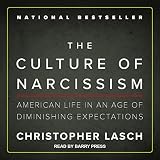
- Audible Audiobook
- Christopher Lasch (Author) - Barry Press (Narrator)
- English (Publication Language)
- 06/27/2017 (Publication Date) - Tantor Audio (Publisher)
A key takeaway from this section is that Lasch views narcissism as a social and historical development, not just an individual failing. For instance, he critiques the rise of self-help culture and therapeutic interventions, suggesting they reinforce narcissistic tendencies by focusing on individual feelings and self-esteem at the expense of shared values and responsibilities.
The Culture Of Narcissism by Christopher Lasch: Strengths and Limitations
The enduring relevance of The Culture of Narcissism lies in its prescient observations about societal trends that continue to resonate. Lasch’s critique of consumerism, the erosion of authority, and the superficiality of public discourse offers a framework for understanding contemporary social dynamics. His detailed historical and philosophical grounding provides a robust intellectual foundation for his arguments.
However, the book’s limitations are also significant. Its prose can be dense and academic, making it inaccessible to a general audience. Furthermore, Lasch’s often pessimistic outlook and his sweeping generalizations can feel overwhelming, and some readers may find his proposed solutions, or lack thereof, unsatisfying. The book’s publication date means some of its specific examples may feel dated, though the underlying cultural critiques remain potent.
Comparison Framework: Lasch and Contemporary Social Critics
When evaluating The Culture of Narcissism, it is useful to compare its arguments to other prominent social critics. Lasch’s work often stands in contrast to more optimistic or technologically deterministic views of society.
| Feature | The Culture of Narcissism (Lasch) | Contemporary Critic A (e.g., Putnam) | Contemporary Critic B (e.g., Pinker) |
|---|---|---|---|
| Primary Focus | Cultural pathology, narcissism | Social capital, community decline | Progress, decline of violence |
| Tone | Pessimistic, critical | Concerned, analytical | Optimistic, data-driven |
| Core Diagnosis | Erosion of self-reliance, narcissism | Decline in civic engagement | Reduction in societal ills |
| Proposed Solution | Revival of tradition, self-governance | Rebuilding social networks | Continued progress through reason |
| Key Evidence | Historical analysis, cultural trends | Statistical data on participation | Statistical data on well-being |
Lasch’s unique contribution lies in his deep dive into the psychological underpinnings of societal decline, framing it as a culture of narcissism. This contrasts with critics who focus more on the observable decline of civic engagement or those who emphasize statistical improvements in human well-being.
Best-Fit Picks by Use Case
- For the Social Historian: The Culture of Narcissism provides a critical lens through which to examine 20th-century American social history, offering a counter-narrative to prevailing ideas of progress.
- For the Critical Thinker: Readers who enjoy dissecting societal trends and questioning established norms will find Lasch’s arguments provocative and engaging.
- For the Policy Analyst: While not a policy prescription guide, the book offers a critique of welfare state mechanisms and therapeutic interventions that can inform policy discussions.
Common Mistakes
- Mistake: Treating narcissism as solely a clinical diagnosis.
- Why it matters: Lasch uses narcissism as a cultural metaphor for a broader societal disposition, not just clinical pathology.
- Fix: Understand narcissism in the book as a pervasive cultural trait affecting behavior and relationships across society.
- Mistake: Expecting a prescriptive self-help guide.
- Why it matters: The book is primarily analytical and critical, not a manual for personal improvement.
- Fix: Approach the book as a diagnosis of societal ills rather than a solution manual.
- Mistake: Overlooking the historical context of its publication.
- Why it matters: The book reflects the social and intellectual climate of the late 1970s.
- Fix: Consider how its arguments have been challenged, affirmed, or evolved in the decades since its release.
- Mistake: Underestimating the density of the prose.
- Why it matters: Lasch’s academic style can be challenging for readers unaccustomed to critical theory.
- Fix: Allocate sufficient time and mental energy for careful reading and reflection.
Decision Rules
- If reliability is your top priority for The Culture Of Narcissism by Christopher Lasch, choose the option with the strongest long-term track record and support.
- If value matters most, compare total ownership cost instead of headline price alone.
- If your use case is specific, prioritize fit-for-purpose features over generic ‘best overall’ claims.
FAQ
- Q1: Is The Culture of Narcissism still relevant today?
A1: Yes, many of Lasch’s observations regarding individualism, consumerism, and the impact of therapeutic culture on society remain highly relevant.
- Q2: What is the main argument of The Culture of Narcissism?
A2: Lasch argues that American society has become dominated by a narcissistic personality type, leading to a decline in communal bonds, historical consciousness, and genuine self-reliance.
- Q3: Who was Christopher Lasch?
A3: Christopher Lasch (1932-1994) was an American historian and social critic known for his critiques of liberalism, consumerism, and modern culture.
- Q4: How does Lasch’s critique differ from modern discussions of narcissism?
A4: Lasch focuses on narcissism as a broad cultural pathology and a historical development, whereas modern discussions often center on clinical diagnosis or online behavior.
- Q5: Should I read The Culture of Narcissism if I’m looking for optimistic social commentary?
A5: No, the book is predominantly critical and pessimistic in its assessment of modern American life. Readers seeking optimistic viewpoints may find it challenging.