Camille Paglia’s ‘Sexual Personae’: A Cultural Analysis
Quick Answer
- ‘Sexual Personae: Art and Decadence from Nefertiti to Emily Dickinson’ by Camille Paglia is a seminal work of cultural criticism arguing that sexuality is the primary engine of Western civilization’s art and history.
- Paglia posits culture as a dynamic interplay between Apollonian (order) and Dionysian (chaos) forces, expressed through recurring “sexual personae” or archetypes.
- This book is a dense, provocative, and challenging read, demanding active engagement with its complex theories and controversial interpretations.
Who This Is For
- Advanced students and scholars in art history, literary criticism, cultural studies, and gender theory seeking a foundational, albeit contentious, theoretical text.
- Readers interested in ambitious, interdisciplinary analyses that connect seemingly disparate cultural phenomena through a psychoanalytic lens.
What to Check First
- Your readiness for dense theoretical prose: Paglia’s writing is intricate and requires sustained focus.
- Your familiarity with Western art and literature: Prior knowledge will significantly enhance comprehension and appreciation of her examples.
- Your openness to psychoanalytic frameworks: The book is heavily influenced by Freudian and Lacanian thought.
- Your tolerance for polemical arguments: Paglia’s viewpoints on gender and sexuality have generated significant debate.
Step-by-Step Plan for Engaging with Sexual Personae by Camille Paglia
This structured approach is recommended for dissecting Camille Paglia’s ‘Sexual Personae’.
1. Grasp the Core Theoretical Framework:
- Action: Begin with Paglia’s introduction and any preliminary sections outlining her methodology.
- What to look for: Her central thesis on the primacy of sexual energy in culture, the Apollonian/Dionysian dynamic, and the concept of “sexual personae.”
- Mistake to avoid: Treating the book as a chronological survey; it is a theoretical argument illustrated by historical and artistic examples.
2. Define Key Analytical Terms:
- Action: Actively identify and define Paglia’s recurring conceptual vocabulary, such as “sexual personae,” “androgyny,” “decadence,” “Apollonian,” and “Dionysian.”
- What to look for: How these terms are consistently applied across diverse analyses to build her overarching argument.
- Mistake to avoid: Assuming standard dictionary definitions; Paglia employs these terms within her specific theoretical structure.
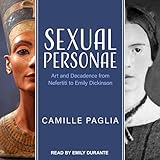
- Audible Audiobook
- Camille Paglia (Author) - Emily Durante (Narrator)
- English (Publication Language)
- 11/07/2017 (Publication Date) - Tantor Audio (Publisher)
3. Critically Analyze Case Studies:
- Action: Engage with specific chapters focusing on particular artists, literary figures, or historical periods (e.g., Nefertiti, Shakespeare, Emily Dickinson).
- What to look for: The specific evidence Paglia presents (artistic details, textual excerpts) and the logical connections she establishes to support her theories.
- Mistake to avoid: Accepting her interpretations uncritically; always question the strength of the evidence and the validity of the inferential leaps.
4. Recognize Psychoanalytic Underpinnings:
- Action: Note instances where Paglia references Freudian or Lacanian psychoanalytic concepts.
- What to look for: How these psychoanalytic ideas underpin and inform her readings of art, literature, and cultural phenomena.
- Mistake to avoid: Overlooking the psychoanalytic framework; it is integral to understanding the logic and depth of her interpretations.
5. Synthesize Arguments Across Chapters:
- Action: Periodically revisit earlier chapters to observe how arguments develop and interrelate.
- What to look for: Recurring patterns in her analysis of different eras and how her core concepts are reinforced or elaborated upon throughout the book.
- Mistake to avoid: Reading each chapter as an isolated essay; the book’s power lies in its cumulative and interconnected argumentation.
6. Evaluate Scholarly Reception:
- Action: Research critical responses and academic debates surrounding ‘Sexual Personae’.
- What to look for: Common points of praise and criticism, particularly regarding her methodology, conclusions, and controversial statements.
- Mistake to avoid: Relying solely on your personal reading; understanding the book’s reception provides essential context for its impact and legacy.
Common Mistakes
- Mistake: Reading ‘Sexual Personae’ as a straightforward historical narrative.
- Why it matters: Paglia uses historical periods and artworks primarily as evidence to support her theoretical framework, not as the central focus of a chronological account.
- Fix: Approach the book as a work of cultural theory that employs historical and artistic examples to illustrate its arguments.
- Mistake: Underestimating the foundational role of psychoanalytic theory.
- Why it matters: Paglia’s interpretations are deeply rooted in Freudian and Lacanian concepts of the unconscious, libido, and repression. Without this lens, her analyses may appear idiosyncratic or unfounded.
- Fix: Be prepared to familiarize yourself with basic psychoanalytic concepts or recognize their application as they appear in the text.
- Mistake: Expecting a neutral, dispassionate academic tone.
- Why it matters: Paglia is a polemicist. Her prose is passionate, opinionated, and often intentionally provocative, aiming to challenge conventional wisdom.
- Fix: Engage with the book as a forceful argument from a distinct perspective, evaluating the strength of her claims rather than seeking detached objectivity.
- Mistake: Dismissing the book solely due to its controversial stances on gender or sexuality.
- Why it matters: While Paglia’s views on these topics are highly debated, they are integral to her overall cultural analysis. Focusing exclusively on controversy can obscure the broader theoretical architecture.
- Fix: Acknowledge the contentious elements but strive to understand the theoretical framework that supports them, separating personal viewpoints from analytical tools.
Sexual Personae by Camille Paglia: A Cultural Analysis
Camille Paglia’s ‘Sexual Personae: Art and Decadence from Nefertiti to Emily Dickinson’ is a foundational, albeit controversial, work of cultural criticism published in 1990. It presents a sweeping, interdisciplinary theory that posits sexuality as the fundamental driving force behind Western civilization’s artistic and historical development. Paglia asserts that culture is engaged in a perpetual, often violent, negotiation between two primal forces: the Apollonian, representing order, reason, and form; and the Dionysian, embodying chaos, passion, and instinct. These forces, she argues, manifest through enduring archetypes known as “sexual personae”—representations of male and female sexuality that have been continually reinterpreted and contested throughout millennia.
Paglia’s methodology is broad and deliberately eclectic, drawing connections between ancient Egyptian sculpture, Renaissance painting, the poetry of Shakespeare, and the works of Emily Dickinson, among many others. Her central thesis is that civilization itself is a precarious construct, an ongoing effort to impose meaning and order upon the overwhelming, often terrifying, forces of nature and human sexuality. This perspective leads her to analyze art and literature through a lens that prioritizes power dynamics, aggression, and the erotic impulse as primary motivators of human creation and societal structures.
A unique and often challenging angle of ‘Sexual Personae’ is its insistence on the visceral, physical, and often violent dimensions of cultural production. Paglia famously states, “Where there is art, there is sex,” a declaration that highlights her conviction in the inseparable link between creative impulse and erotic drives. This is not a reductive claim but an argument that art functions as a crucial mechanism for humanity to grapple with, sublimate, and attempt to control these fundamental biological forces. Artistic creation, in her view, is a direct engagement with the raw materials of human experience, particularly its sexual and aggressive components, serving as a means of both expression and control.
The Apollonian and Dionysian in Sexual Personae by Camille Paglia
The Apollonian and Dionysian dichotomy, a concept Paglia directly inherits from Friedrich Nietzsche, serves as the bedrock of her analytical framework in ‘Sexual Personae’. The Apollonian embodies principles of order, clarity, reason, and the imposition of form and structure. In art, this translates to precise lines, balanced compositions, and rational organization, exemplified by classical Greek sculpture or the rational humanism of the High Renaissance. Conversely, the Dionysian represents chaos, passion, instinct, and the dissolution of boundaries. It manifests in art through ecstatic abandon, overwhelming emotion, and the blurring of identities, observable in phenomena such as ecstatic cults or the untamed, sublime landscapes of Romantic painting.
Paglia posits that Western culture is characterized by a continuous, cyclical oscillation between these two primal forces. Periods dominated by Apollonian order and reason are inevitably followed by Dionysian excesses and eventual collapse, which then necessitate a reassertion of order. This cyclical movement, she argues, shapes the evolution of art, literature, and societal norms. For instance, she interprets the structured humanism of the Renaissance as an Apollonian triumph, while the dramatic, often macabre, intensity of Gothic literature reflects a Dionysian engagement with fear, the sublime, and the breakdown of order. This interpretive lens allows her to analyze a vast spectrum of cultural phenomena—from the stylized power of Egyptian deities to the introspective torment of Romantic poets—as manifestations of this fundamental cultural dynamic, driven by the tension between control and primal energy.
Expert Tips
- Tip: Focus on identifying recurring archetypal patterns.
- Action: As you read, actively look for how Paglia applies specific archetypal “sexual personae” (e.g., the Virgin, the Androgyne, the Great Mother) to different subjects and how these archetypes relate to the Apollonian/Dionysian dynamic.
- Mistake to avoid: Treating each chapter’s subject in isolation; recognizing the archetypal framework provides thematic cohesion and reveals the cumulative nature of her argument.
- Tip: Cross-reference with established historical and literary context.
- Action: When Paglia presents a specific historical detail, artistic interpretation, or literary analysis that seems unusual or lacks immediate clarity, briefly consult reputable academic sources or encyclopedias for corroboration or alternative viewpoints.
- **Mistake to
Quick Comparison
| Option | Best for | Pros | Watch out |
|---|---|---|---|
| Quick Answer | General use | ‘Sexual Personae: Art and Decadence from Nefertiti to Emily Dickinson’ by Cam… | Mistake to avoid: Treating the book as a chronological survey; it is a theore… |
| Who This Is For | General use | Paglia posits culture as a dynamic interplay between Apollonian (order) and D… | Mistake to avoid: Assuming standard dictionary definitions; Paglia employs th… |
| What to Check First | General use | This book is a dense, provocative, and challenging read, demanding active eng… | Mistake to avoid: Accepting her interpretations uncritically; always question… |
| Step-by-Step Plan for Engaging with Sexual Personae by Camille Paglia | General use | Advanced students and scholars in art history, literary criticism, cultural s… | Mistake to avoid: Overlooking the psychoanalytic framework; it is integral to… |
Decision Rules
- If reliability is your top priority for Sexual Personae by Camille Paglia, choose the option with the strongest long-term track record and support.
- If value matters most, compare total ownership cost instead of headline price alone.
- If your use case is specific, prioritize fit-for-purpose features over generic ‘best overall’ claims.