C. S. Lewis’s That Hideous Strength: An Overview
This overview provides a focused examination of C. S. Lewis’s That Hideous Strength, the final installment of his Space Trilogy. It aims to equip readers with a clear understanding of the novel’s core themes, potential interpretive challenges, and its place within Lewis’s broader literary and philosophical landscape.
That Hideous Strength by C. S. Lewis: Who This Is For
- Readers interested in C. S. Lewis’s speculative fiction and its engagement with philosophical and theological ideas.
- Individuals seeking to understand the allegorical and critical dimensions of That Hideous Strength beyond its science fiction elements.
That Hideous Strength by C. S. Lewis: What to Check First
Before diving into That Hideous Strength, consider the following:
- Prior Reading: While it can be read as a standalone work, understanding Out of the Silent Planet and Perelandra enhances the thematic continuity and character development.
- Lewis’s Philosophical Stance: Familiarity with Lewis’s Christian apologetics and his critiques of scientism and totalitarianism provides essential context for his allegorical critiques.
- Publication Context: The novel was published in 1945, reflecting post-war anxieties about unchecked scientific advancement and societal control.
Step-by-Step Plan to Understanding That Hideous Strength
Engaging with That Hideous Strength by C. S. Lewis requires a methodical approach to unpack its layered narrative and thematic density.
1. Identify the Central Conflict: Observe the clash between the National Institute of Co-Ordinated Experiments (N.I.C.E.) and the Pendragon community.
- What to look for: N.I.C.E.’s promotion of a purely materialistic worldview versus Pendragon’s alignment with older, spiritual traditions.
- Mistake to avoid: Viewing N.I.C.E. solely as a scientific institution without recognizing its underlying ideological agenda.
2. Analyze Mark and Jane Studdock: Track their individual journeys and their evolving relationship.
- What to look for: Mark’s susceptibility to N.I.C.E.’s promises of intellectual and social advancement, and Jane’s gradual awakening to spiritual realities.
- Mistake to avoid: Underestimating the significance of their personal transformations as microcosms of broader societal choices.
3. Examine the Role of Science and Technology: Note how Lewis portrays scientific progress and its ethical implications.
- What to look for: The perversion of scientific inquiry by N.I.C.E. for control and power, contrasting with genuine, divinely-guided knowledge.
- Mistake to avoid: Interpreting Lewis’s critique as a blanket condemnation of science itself, rather than a critique of its misuse.
4. Recognize the Mythological and Symbolic Elements: Identify references to Arthurian legend and Christian symbolism.
- What to look for: The presence of figures like Merlin and the symbolic weight of the “Idols” within N.I.C.E.
- Mistake to avoid: Dismissing these elements as mere literary embellishment; they are integral to the novel’s allegorical structure.
5. Deconstruct the Nature of Evil: Observe how Lewis depicts evil not just as absence of good, but as active, intelligent malevolence.
- What to look for: The chillingly rational yet ultimately destructive goals of the N.I.C.E. leadership and the unseen forces they serve.
- Mistake to avoid: Expecting overt, cartoonish villainy; Lewis presents a more insidious, bureaucratic form of evil.
If you’re looking to dive into C. S. Lewis’s final Space Trilogy installment, securing a copy of ‘That Hideous Strength’ is your first step. This edition offers the complete text for your exploration.
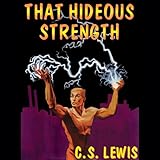
- Audible Audiobook
- C. S. Lewis (Author) - Geoffrey Howard (Narrator)
- English (Publication Language)
- 05/13/2005 (Publication Date) - Blackstone Audio, Inc. (Publisher)
6. Assess the Theme of True vs. False Education: Understand how Lewis contrasts N.I.C.E.’s indoctrination with genuine intellectual and spiritual formation.
- What to look for: The sterile, manipulative curriculum at N.I.C.E. versus the wisdom sought and found by characters like Jane.
- Mistake to avoid: Equating intellectualism with true wisdom; Lewis emphasizes discernment and moral grounding.
Failure Mode: Misinterpreting the Allegory
A common failure mode for readers of That Hideous Strength by C. S. Lewis is a misinterpretation of its allegorical depth, often due to focusing too narrowly on its science fiction or satirical elements.
- Detection: Readers may express confusion about the motivations of characters or the ultimate meaning of events, viewing the plot as merely a critique of mid-20th-century academic or political trends. They might dismiss the supernatural or spiritual dimensions as extraneous or underdeveloped.
- Early Warning Signs: If a reader consistently questions “why” characters behave in ways that seem illogical from a purely secular standpoint, or if they find the novel’s resolution unsatisfying because it relies on non-material forces, they are likely missing the allegorical framework.
- Correction: To avoid this, approach the novel with an awareness of Lewis’s known philosophical and theological commitments. Recognize that the “science” and “politics” are often vehicles for exploring deeper questions about humanity’s relationship with the divine, the nature of reality, and the battle against spiritual forces. Understanding That Hideous Strength as a spiritual allegory, rather than just a social commentary or sci-fi thriller, is crucial for a complete reading.
Common Myths
- Myth: That Hideous Strength is simply a science fiction story about a dystopian future.
- Why it matters: This view overlooks the novel’s primary function as an allegory and Lewis’s critique of specific ideologies.
- Fix: Recognize the science fiction elements as a framework for exploring Lewis’s theological and philosophical concerns about scientism, materialism, and the nature of good and evil.
- Myth: The novel is a direct attack on all scientific progress.
- Why it matters: This misrepresents Lewis’s nuanced position, which criticizes the misuse of science and the reductionist worldview it can foster, not science itself.
- Fix: Distinguish between science as a tool for understanding and science as a dogma that denies spiritual reality. Lewis’s critique targets the latter.
- Myth: The ending is abrupt and lacks resolution because the plot is weak.
- Why it matters: The resolution is thematic and spiritual, not purely plot-driven, and requires understanding the allegorical stakes.
- Fix: Appreciate that the conclusion emphasizes divine intervention and the ultimate triumph of spiritual order over materialistic chaos, aligning with Lewis’s worldview.
Expert Tips
- Tip 1: Contextualize the “Inner Ring.”
- Actionable Step: Pay close attention to how characters seek acceptance and power within the N.I.C.E. hierarchy.
- Common Mistake to Avoid: Dismissing the concept of the “Inner Ring” as a minor detail; it’s a key theme from Lewis’s essay of the same name, illustrating the destructive allure of belonging to exclusive groups, regardless of their moral standing.
- Tip 2: Trace the Spiritual Trajectory.
- Actionable Step: Map the spiritual and psychological development of key characters, particularly Jane Studdock.
- Common Mistake to Avoid: Focusing solely on the external plot events without tracking the internal shifts in characters’ beliefs and perceptions, which are central to Lewis’s message.
- Tip 3: Understand the “Logres” Symbolism.
- Actionable Step: Note references to Arthurian mythology and the concept of “Logres” as a spiritual kingdom.
- Common Mistake to Avoid: Treating the Arthurian elements as mere window dressing; they are intended to evoke a lost ideal of Christian civilization and its potential restoration.
BLOCKQUOTE_0
This quote encapsulates Lewis’s critique of a modern worldview that dismisses fundamental spiritual realities based on prevailing materialistic assumptions.
Decision Rules
- If reliability is your top priority for That Hideous Strength by C. S. Lewis, choose the option with the strongest long-term track record and support.
- If value matters most, compare total ownership cost instead of headline price alone.
- If your use case is specific, prioritize fit-for-purpose features over generic ‘best overall’ claims.
FAQ
- Q: Is That Hideous Strength a sequel to Perelandra?
- A: Yes, it is the third and final novel in C. S. Lewis’s Space Trilogy, continuing some narrative threads and thematic concerns from the previous books.
- Q: What is the primary message of That Hideous Strength?
- A: The novel’s primary message critiques the dangers of scientism, the dehumanizing effects of totalitarian ideologies, and the spiritual battle between good and evil, advocating for a worldview grounded in faith and transcendent truth.
- Q: Should I read the other books in the Space Trilogy first?
- A: While That Hideous Strength can be understood independently, reading Out of the Silent Planet and Perelandra first provides a richer understanding of Lewis’s created universe, character arcs, and thematic development.
- Q: How does That Hideous Strength relate to C. S. Lewis’s other works?
- A: It shares themes with his apologetic works, such as The Abolition of Man, and his allegorical fiction, exploring the clash between Christian principles and secular humanism.
| Element | Description | Significance |
|---|---|---|
| N.I.C.E. | The National Institute of Co-Ordinated Experiments, a seemingly progressive organization with sinister aims. | Represents the dangers of unchecked scientific ambition, bureaucratic control, and the suppression of spiritual truth. |
| Pendragon House | A rural estate and community associated with ancient traditions and spiritual wisdom. | Symbolizes a resistance to modernity’s soulless materialism, embodying a connection to older, divinely-ordained ways |