Brian Christian’s Algorithms to Live By
Quick Answer
- Algorithms To Live By by Brian Christian translates complex computer science concepts into actionable life strategies.
- It offers a systematic approach to everyday decision-making, from dating to managing tasks.
- Readers seeking structured methods for optimizing choices will find value, while those preferring intuitive approaches may find it overly prescriptive.
Who This Is For
- Individuals interested in applying computational thinking to personal and professional challenges.
- Readers who appreciate evidence-based frameworks for improving decision-making processes.
What To Check First
- Core Concepts: Understand that the book uses algorithms as metaphors for decision-making strategies, not literal code.
- Applicability: Consider if you are open to applying structured, rule-based approaches to areas often governed by intuition or emotion.
- Author’s Approach: Brian Christian draws heavily from computer science research; evaluate if this analytical style aligns with your learning preferences.
- Examples: Note that examples range from managing email inboxes to finding parking spots, illustrating the breadth of application.
Step-by-Step Plan: Applying Algorithms To Live By by Brian Christian
1. Understand the Principle of Exploration vs. Exploitation
- Action: Identify a recurring decision point in your life where you either stick with a known good option (exploitation) or try new ones (exploration).
- What to Look For: Recognize situations where you might be missing out on better opportunities by always choosing the familiar, or conversely, wasting time on too many unproven options.
- Mistake: Treating exploration as inherently better than exploitation, or vice versa, without considering the context and potential costs.
2. Implement the “Optimal Stopping” Strategy for Selections
- Action: When faced with a sequence of choices (e.g., apartments, job candidates), commit to evaluating a fixed percentage (typically 37%) of options before making a decision.
- What to Look For: Observe if you tend to make decisions too quickly or delay them indefinitely. This strategy provides a clear boundary.
- Mistake: Applying a rigid 37% rule without considering the consequences of missing out on a truly exceptional early option or the risk of settling for a suboptimal later one.
3. Utilize Sorting Algorithms for Prioritization
- Action: Apply sorting principles (like quicksort or merge sort) to your to-do lists or incoming information by establishing clear criteria for comparison.
- What to Look For: Assess if your current methods for organizing tasks lead to overwhelm or inefficiency. Structured sorting can bring clarity.
- Mistake: Overcomplicating the sorting criteria, making the process of organization more time-consuming than the tasks themselves.
4. Manage Uncertainty with Bayesian Inference
- Action: When new information arrives that contradicts your prior beliefs, consciously adjust your confidence level based on the strength of the new evidence, rather than dismissing it.
- What to Look For: Notice instances where you rigidly adhere to initial assumptions despite contradictory data.
- Mistake: Underestimating or overestimating the impact of new information, leading to biased updates of your beliefs.
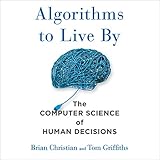
Algorithms to Live By: The Computer Science of Human Decisions
- Audible Audiobook
- Brian Christian (Author) - Brian Christian (Narrator)
- English (Publication Language)
- 04/19/2016 (Publication Date) - Brilliance Audio (Publisher)
5. Embrace Randomization for Breaking Indecision
- Action: For low-stakes decisions where you are stuck between equally appealing options, use a randomizer (like a coin flip or a random number generator) to break the tie.
- What to Look For: Identify situations where prolonged deliberation over minor choices leads to decision fatigue.
- Mistake: Applying randomization to significant decisions where thorough analysis is warranted, or using it as an excuse to avoid responsibility.
Common Mistakes
- Mistake: Treating algorithms as rigid prescriptions rather than flexible frameworks.
- Why it matters: Life is complex and rarely fits perfect mathematical models. Over-adherence can lead to suboptimal outcomes in nuanced situations.
- Fix: View algorithms as tools to guide thinking, not dictates. Always allow for contextual adjustments and human judgment.
- Mistake: Overestimating the applicability of complex algorithms to simple, everyday problems.
- Why it matters: Applying a sophisticated algorithm where a simple heuristic suffices can create unnecessary complexity and mental overhead.
- Fix: Prioritize simplicity. Use the least complex effective strategy for a given problem.
- Mistake: Neglecting the “exploration” phase in favor of immediate “exploitation.”
- Why it matters: Sticking only with what is known can lead to missed opportunities for better solutions or experiences.
- Fix: Consciously build in periods of exploration for important decisions, even if it means a slight initial inefficiency.
- Mistake: Applying decision-making algorithms without considering the emotional or social context.
- Why it matters: Human interactions and personal well-being are not purely logical. Purely algorithmic decisions can be alienating or detrimental.
- Fix: Integrate algorithmic strategies with an awareness of human factors. For example, use algorithms to narrow down options, but rely on human connection for final relationship decisions.
Quick Comparison
| Option | Best for | Pros | Watch out |
|---|---|---|---|
| Quick Answer | General use | Algorithms To Live By by Brian Christian translates complex computer science… | Mistake: Treating exploration as inherently better than exploitation, or vice… |
| Who This Is For | General use | It offers a systematic approach to everyday decision-making, from dating to m… | Mistake: Applying a rigid 37% rule without considering the consequences of mi… |
| What To Check First | General use | Readers seeking structured methods for optimizing choices will find value, wh… | Mistake: Overcomplicating the sorting criteria, making the process of organiz… |
| Step-by-Step Plan Applying Algorithms To Live By by Brian Christian | General use | Individuals interested in applying computational thinking to personal and pro… | Mistake: Underestimating or overestimating the impact of new information, lea… |
Decision Rules
- If reliability is your top priority for Algorithms To Live By by Brian Christian, choose the option with the strongest long-term track record and support.
- If value matters most, compare total ownership cost instead of headline price alone.
- If your use case is specific, prioritize fit-for-purpose features over generic ‘best overall’ claims.
FAQ
- Q: Are these algorithms meant to be programmed and run?
- A: No, the book uses algorithms as conceptual models for human decision-making strategies. They are mental frameworks, not literal computer code to be executed.
- Q: Can these strategies help with creative tasks?
- A: While the book focuses on optimization and decision-making, principles like managing exploration vs. exploitation can inform creative processes by helping balance trying new ideas with refining existing ones.
- Q: What is the primary takeaway from Algorithms To Live By by Brian Christian?
- A: The primary takeaway is that structured, algorithmic thinking can provide valuable frameworks for navigating the complexities and uncertainties of everyday life, leading to more efficient and effective decisions.
- Q: How does this book differ from self-help books that focus on intuition?
- A: This book differentiates itself by grounding its advice in the rigorous logic of computer science, offering systematic, often counter-intuitive, approaches rather than relying solely on gut feelings.
- Q: Is there a risk of becoming too robotic by following these strategies?
- A: There is a risk if the strategies are applied rigidly without considering human context. The book itself advocates for understanding the limitations of algorithms and when to deviate.
Expert Tips
- Tip: When faced with a long list of items to evaluate (e.g., potential vacation destinations, software choices), use the “secretary problem” approach.
- Actionable Step: Decide beforehand to examine a specific percentage (around 37%) of your options without committing, and then choose the first option thereafter that surpasses the best one you’ve seen so far.
- Common Mistake to Avoid: Committing to the first appealing option you encounter without first exploring a sufficient portion of the available choices.
- Tip: For managing an overflowing inbox or a complex project, employ a “sorting” strategy.
- Actionable Step: Define clear, hierarchical criteria for categorizing and prioritizing tasks or messages. Implement a system where items are moved through defined stages.
- Common Mistake to Avoid: Creating an overly complex sorting system that requires more time to manage than the items being sorted.
- Tip: Leverage the concept of “randomization” to overcome decision paralysis on low-stakes choices.
- Actionable Step: For decisions where multiple options are equally acceptable and prolonged deliberation is unproductive, use a random selection method (e.g., a dice roll, a random number generator).
- Common Mistake to Avoid: Applying randomization to critical decisions that require careful analysis and consideration of significant consequences.
Common Myths
- Myth: Algorithms are only for computers and have no place in human decision-making.
- Correction: The book demonstrates that many human decision-making processes, from choosing a spouse to managing time, can be modeled and improved using algorithmic principles like optimal stopping, sorting, and Bayesian inference. These are conceptual tools for thought, not literal code.
- Myth: Applying algorithms will make life predictable and remove spontaneity.
- Correction: While algorithms provide structure, they are often used to manage uncertainty and improve the quality of choices, not to eliminate surprise. For instance, understanding exploration vs. exploitation can lead to more meaningful spontaneous discoveries by balancing routine with novelty.
BLOCKQUOTE_0
Algorithms To Live By by Brian Christian: Strengths and Limitations
Strengths
- Intellectual Rigor: The book successfully bridges complex computer science theory with practical, everyday applications, offering a unique perspective on decision-making.
- Actionable Frameworks: It provides concrete strategies that readers can immediately implement to tackle common life challenges, such as managing information overload or making sequential choices.
- Engaging Narrative: Brian Christian presents abstract concepts through relatable anecdotes and clear explanations, making the material accessible and interesting.
Limitations
- Potential for Over-Prescription: Some readers might find the algorithmic approach too rigid, potentially overlooking the nuances of human emotion and intuition in decision-making.
- Contextual Applicability: The effectiveness of specific algorithms can vary greatly depending on the situation, and readers must exercise judgment to determine when and how to apply them.
Reading Context
This book is best read by individuals who are looking for structured, analytical approaches to improve their decision-making. It serves as an excellent complement to more intuitive or philosophical self-help guides. For those who prefer a more abstract or purely narrative approach to life advice, Algorithms To Live By by Brian Christian might feel overly technical.