Barbara Tuchman’s The Guns of August: World War I
Quick Answer
- The Guns of August by Barbara Wertheim Tuchman offers a vivid, narrative-driven account of the crucial opening month of World War I, highlighting the critical decisions and strategic missteps that plunged Europe into conflict.
- Its strength lies in its compelling portrayal of key figures, their flawed planning, and the human drama behind the war’s genesis, making complex history accessible and engaging.
- This book is best suited for readers who appreciate narrative history and character-focused analysis of historical events, rather than purely technical military strategy.
Who This Is For
- Readers seeking an immersive understanding of the immediate causes and the critical first month of World War I, focusing on the political and military decisions of 1914.
- Individuals who enjoy meticulously researched historical accounts that bring historical figures and pivotal moments to life through engaging prose.
What to Check First
- Narrative Emphasis: Understand that Tuchman’s primary tool is compelling storytelling and character analysis, not a data-driven strategic breakdown.
- Temporal Scope: Confirm your interest lies specifically in the lead-up to and the initial month of WWI, as this is the precise focus of the book.
- Historical Interpretation: Be aware that Tuchman’s influential interpretation, particularly concerning German responsibility, has been a subject of ongoing historical debate and refinement.
- Pacing and Detail: Recognize that the book meticulously details intricate plans and early skirmishes, building momentum toward the war’s larger unfolding.
Step-by-Step Plan: Engaging with The Guns of August by Barbara Wertheim Tuchman
1. Establish Pre-War Alliances: Before delving into the narrative, identify the primary European alliances (Triple Entente and Triple Alliance) and their core member nations.
- Action: Briefly review a timeline or overview of European geopolitical alignments prior to 1914.
- What to look for: The fundamental power structures and rivalries that defined international relations.
- Mistake: Beginning the book without understanding the foundational political landscape can lead to confusion regarding national motivations and strategic considerations.
2. Identify Key Decision-Makers: As Tuchman introduces them, make a note of the principal military and political leaders of the major powers.
- Action: Create a brief list of individuals such as Kaiser Wilhelm II, Helmuth von Moltke, Sir Edward Grey, and their respective nations.
- What to look for: Their perceived influence, stated objectives, and personal characteristics as depicted by Tuchman.
- Mistake: Underestimating the impact of individual agency and leadership, which diminishes the book’s core focus on human decision-making as a driver of events.
3. Deconstruct the Schlieffen Plan: Pay close attention to the detailed explanations of Germany’s military strategy for a potential two-front war.
- Action: Note the plan’s objectives, the critical role assigned to Belgium, and the assumed speed of its execution.
- What to look for: The inherent rigidity of the plan and the specific assumptions upon which it was built.
- Mistake: Skimming over the military planning details will reduce clarity regarding the subsequent unfolding of events and the reasons for the plan’s eventual failure.
4. Trace the Diplomatic Breakdown: Follow the sequence of events during the July Crisis of 1914, noting key communications and ultimatums.
- Action: Highlight or annotate instances of diplomatic exchanges, particularly the “blank check” and the mobilization orders.
- What to look for: The communication gaps, missed opportunities for de-escalation, and the perceived inflexibility of national positions.
- Mistake: Assuming all diplomatic channels were equally engaged or effective; Tuchman emphasizes their often-futile nature against escalating military imperatives.
5. Observe the Transition from Planning to Reality: Track how meticulously crafted military plans began to falter when confronted with actual battlefield conditions.
- Action: Compare the planned troop movements and timetables with actual reports from the front lines.
- What to look for: Points of divergence, unforeseen challenges, and the initial signs of the plan’s unraveling.
- Mistake: Believing the initial war plans were fully realized; the book emphasizes their rapid obsolescence and the ensuing chaos.
6. Note the Influence of Technology and Logistics: Observe how infrastructure and communication systems impacted military operations.
- Action: Look for descriptions of railway mobilization schedules, telegraph communications, and supply chain challenges.
- What to look for: How these logistical elements constrained or enabled military actions and decision-making.
- Mistake: Underestimating the role of logistics and technology, which Tuchman skillfully integrates into the narrative of human decisions and battlefield realities.
For a compelling and narrative-driven account of the crucial opening month of World War I, Barbara Tuchman’s The Guns of August is an exceptional choice. It masterfully details the critical decisions and strategic missteps that plunged Europe into conflict.
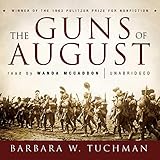
- Audible Audiobook
- Barbara W. Tuchman (Author) - Wanda McCaddon (Narrator)
- English (Publication Language)
- 04/28/2008 (Publication Date) - Blackstone Audio, Inc. (Publisher)
7. Consider the “Fog of War”: Understand how uncertainty, incomplete intelligence, and psychological pressures affected leadership.
- Action: Identify instances where leaders acted on flawed, outdated, or misinterpreted information.
- What to look for: The inherent chaos of early 20th-century warfare and the psychological burden on commanders.
- Mistake: Applying modern understanding of information flow to historical events; Tuchman illustrates the severe limitations of communication and intelligence at the time.
The Guns of August by Barbara Wertheim Tuchman: A Masterclass in Historical Narrative
Barbara Tuchman’s The Guns of August by Barbara Wertheim Tuchman stands as a monumental achievement in historical writing, offering an immersive and deeply human account of the opening month of World War I. The book’s signal strength lies in its narrative prowess, transforming complex geopolitical maneuvers and rigid military doctrines into a compelling, almost novelistic, experience. Tuchman’s prose breathes life into the era, presenting vivid portraits of leaders grappling with immense pressure, often driven by outdated military dogma and personal pride. This character-driven approach makes the often-impersonal machinery of war feel intensely human, powerfully illustrating the tragic consequences of flawed decision-making.
The book’s primary contribution is its meticulous dissection of August 1914, demonstrating how a series of calculated risks, misjudgments, and inflexible plans spiraled into a global conflict. Tuchman masterfully reconstructs the diplomatic crises, the intricate military strategies—most notably the Schlieffen Plan—and the initial battles, revealing how the war’s initial trajectory was largely set within those critical first weeks. Her narrative underscores the widespread belief on all sides that the war would be short, a conviction that proved disastrously wrong. The literary quality of The Guns of August by Barbara Wertheim Tuchman earned it widespread acclaim and a Pulitzer Prize, cementing its status as a seminal work in popular history.
Common Mistakes
- Accepting Tuchman’s Thesis as Definitive without Nuance:
- Why it matters: Tuchman presented a compelling argument for German war guilt and the Kaiser’s pivotal role. However, later historical scholarship has introduced more complex analyses of shared responsibility among all major powers and the systemic factors contributing to the war.
- Fix: Approach Tuchman’s interpretation as a powerful, well-argued narrative thesis, but remain open to consulting other historical works that offer alternative or complementary perspectives on the war’s origins.
- Underestimating the Role of Individual Agency:
- Why it matters: Tuchman places significant emphasis on the personalities, decisions, and miscalculations of key leaders. If a reader dismisses these as mere anecdotes, they miss the book’s central argument about how human fallibility and strategic rigidity led to war.
- Fix: Actively track the decisions and motivations of the prominent figures discussed, recognizing them as critical drivers of the events described.
- Skipping the Early Diplomatic Chapters:
- Why it matters: The build-up to war is as crucial as the battles themselves. Tuchman dedicates substantial space to the diplomatic crises of July 1914, illustrating the breakdown of communication and the escalating tensions that made war seem inevitable.
- Fix: Read the initial chapters with as much attention as the battle sequences, as they lay the groundwork for understanding why war became the perceived only option for many leaders.
Decision Rules for Engaging with Historical Texts
- Prioritize Source Diversity: When engaging with any historical account, especially one as influential as Tuchman’s, seek out multiple perspectives to build a comprehensive understanding.
- Evaluate Narrative Bias: Recognize that all historical writing involves interpretation. Identify the author’s thesis and consider how their narrative choices might shape the reader’s perception.
- Contextualize Historical Interpretations: Understand that historical scholarship evolves. What was considered definitive in one era may be nuanced or challenged by later research.
FAQ
Q1: Is The Guns of August a good starting point for learning about World War I?
A1: Yes, it is an excellent starting point for understanding the war’s immediate origins and the critical first month. However, it focuses specifically on this period and does not cover the entire war’s duration or aftermath in detail.
Q2: Does the book focus more on military strategy or political causes?
A2: Tuchman masterfully blends both. The book delves deeply into the military plans, such as the Schlieffen Plan, but also thoroughly explores the political climate, diplomatic failures, and the personalities of leaders that led to the outbreak of hostilities.
Q3: How does Tuchman’s writing style compare to more academic historical texts?
A3: Tuchman’s style is renowned for its narrative flair, vivid descriptions, and character-driven approach, making it highly accessible and engaging for general readers. While rigorously researched, it prioritizes storytelling over dense academic analysis, distinguishing it from more specialized scholarly works.
Expert Tips for Reading The Guns of August
- Tip 1: Map the Key Players and Their Objectives.
- Actionable Step: Create a simple chart or list as you encounter them, noting the nation, the primary leader(s) (e.g., Kaiser Wilhelm II, Tsar Nicholas II, Raymond Poincaré), and their stated goals or perceived threats at the outset of the crisis.
- Common Mistake to Avoid: Trying to remember everyone’s role and allegiance solely from memory. This can lead to confusion as multiple nations and their leaders are introduced rapidly.
- Tip 2: Visualize the Schlieffen Plan’s Logistics.
- Actionable Step: When Tuchman describes the German army’s plan to march through Belgium, pause and sketch a rough map showing the intended route and the sequential nature of the attacks. Note the precise timetables mentioned.
- Common Mistake to Avoid: Glancing over the detailed descriptions of troop movements and timetables. The inflexibility and assumed speed of this plan are central to Tuchman’s argument about its inherent flaws and contribution to the war’s outbreak.
- Tip 3: Identify Moments of Diplomatic Miscalculation.
- Actionable Step: Highlight or make a note of specific instances where diplomatic communication failed, misunderstandings occurred, or ultimatums were issued without adequate follow-through. Look for the “point of no return.”
- Common Mistake to Avoid: Assuming that all diplomatic efforts were equally weighted or that key figures fully grasped the consequences of their actions. Tuchman emphasizes the critical role of misjudgment and missed opportunities in the July Crisis.
The Guns of August by Barbara Wertheim Tuchman: A Critical Perspective
While universally praised for its narrative power, The Guns of August by Barbara Wertheim Tuchman is not without its points of contention among historians. Tuchman’s thesis, particularly regarding German war guilt and the Kaiser’s perceived erratic leadership, was a dominant interpretation for decades. However, subsequent scholarship has introduced more nuanced perspectives on the collective responsibility of all major powers and the complex interplay of military planning, alliance systems, and domestic political pressures across Europe.
A potential failure mode for readers engaging with this book is accepting its conclusions as the definitive final word on the war’s origins without critical engagement. Tuchman’s prose, while brilliant, can sometimes imbue her interpretations with an authority that might overshadow alternative viewpoints. The book excels at showing how the war started through the lens of the decision-makers, but it is less focused on the deep-seated systemic causes that other historians explore.
Detecting Reader Failure Mode: Over-Reliance on Tuchman’s Thesis
- Failure Mode: Readers may internalize Tuchman’s specific interpretation of German culpability and Kaiser Wilhelm II’s role as the sole or primary driver of the war, overlooking the broader context of European militarism and alliance dynamics.
- Detection: If, after reading, your primary takeaway is that “Germany and the Kaiser alone caused WWI,” you may have fallen into this trap. A balanced understanding would acknowledge multiple contributing factors.
- Mitigation: Actively seek out historical analyses that discuss the roles of Russia, Austria-Hungary, France, and Britain in the lead-up to the war, and consider theories that emphasize structural factors (like the alliance system or arms race) alongside individual agency.
BLOCKQUOTE_0
Historical Context and Themes
The Guns of August by Barbara Wertheim Tuchman emerged in 1962, a period when the world was still grappling with the specter of nuclear annihilation and the complex legacies of two world wars. Tuchman’s narrative, focusing on the catastrophic miscalculations of 1914, served as a potent reminder of how easily human error, pride, and rigid adherence to outdated doctrines could lead to unimaginable destruction. The book’s enduring relevance lies in its exploration of themes such as:
- The Illusion of Control: How leaders believed they could manage and direct the forces they unleashed, only to be overwhelmed by them.
- The Tyranny of the Plan: The danger of rigid military doctrines that cannot adapt to the realities of conflict.
- The Human Element in History: The profound impact of individual personalities, biases, and decisions on the course of global events.
These themes resonate deeply in any era marked by international tension and the potential for large-scale conflict, making Tuchman’s work a timeless examination of the human capacity for both foresight and catastrophic error.
| Aspect | Tuchman’s Focus | Reader Takeaway | Alternative Perspectives |
|---|