Arthur Koestler’s Darkness at Noon: Political Intrigue
Darkness at Noon by Arthur Koestler: Quick Answer
- Darkness at Noon by Arthur Koestler is a seminal allegorical novel dissecting the psychological and ideological mechanisms of totalitarian regimes, particularly drawing parallels to the Soviet purges.
- It offers a profound exploration of how absolute power corrupts truth, individual conscience, and identity, presenting a stark examination of political control and its human cost.
- Readers should approach this work for its thematic depth and philosophical inquiry into the nature of power and ideology, rather than as a direct historical account.
Who This Is For
- Individuals seeking to understand the inner workings of totalitarian systems and the philosophical justifications used to maintain them.
- Readers interested in literary fiction that grapples with morality, confession, and the disintegration of self under extreme political pressure.
What to Check First
Before engaging with Darkness at Noon by Arthur Koestler, consider these points for a richer understanding:
- Historical Context: The novel is deeply rooted in the Soviet Union’s Great Purge era of the 1930s. Familiarity with the Moscow Show Trials and the fate of “Old Bolsheviks” provides essential background.
- Allegorical Intent: Recognize that Darkness at Noon functions as a philosophical allegory. Koestler uses the narrative to explore abstract concepts of power, ideology, and human psychology, rather than to provide a literal historical record.
- Protagonist’s Journey: Nikolai Ivanovich Rubashov embodies the revolutionary who becomes ensnared by the system he helped create. His internal conflict and moral reckoning are central to the novel’s impact.
- Ideological Conflict: The core tension lies between individual conscience and the Party’s doctrine of “historical necessity.” Grasping this conflict is key to understanding the novel’s arguments.
Step-by-Step Plan for Engaging with Darkness at Noon
To fully appreciate the thematic complexity of Darkness at Noon by Arthur Koestler, a structured reading approach is beneficial:
1. Analyze Rubashov’s Prison Monologues:
- Action: Dedicate close attention to Rubashov’s internal reflections and memories while he is imprisoned.
- What to Look For: Identify how these passages reveal his past revolutionary actions, his evolving justifications, and the burgeoning doubts that may have preceded his downfall. Note specific instances where his earlier beliefs clash with his present reality.
- Mistake to Avoid: Treating these sections as mere narrative exposition; they are vital for understanding Rubashov’s psychological disintegration and the novel’s core themes.
2. Deconstruct Interrogation Dialogues:
- Action: Examine the philosophical and psychological exchanges between Rubashov and his interrogators, particularly Ivanov.
- What to Look For: Analyze the arguments presented, focusing on how the interrogators redefine concepts like “truth,” “guilt,” and “logic” to conform to Party doctrine. Note the specific tactics employed to break Rubashov’s resistance.
- Mistake to Avoid: Perceiving these dialogues as simple plot advancement; they are the intellectual battleground where the novel’s central themes of ideology versus conscience are contested.
For those seeking to understand the chilling realities of totalitarian regimes, Arthur Koestler’s Darkness at Noon is an essential read. This allegorical novel masterfully dissects the psychological and ideological mechanisms that underpin absolute power.
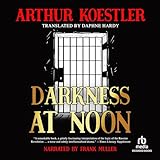
- Audible Audiobook
- Arthur Koestler (Author) - Frank Muller (Narrator)
- English (Publication Language)
- 11/18/2009 (Publication Date) - Recorded Books (Publisher)
3. Track the Concept of “Logical Necessity”:
- Action: Observe how the idea of “logical necessity” is invoked to justify actions, including confessions and executions.
- What to Look For: Identify instances where this term is used by Rubashov or his interrogators. Consider its meaning within the totalitarian system, where it often functions as a euphemism for ideological dogma.
- Mistake to Avoid: Accepting the term at face value; recognize it as a tool designed to suppress individual will and enforce conformity.
4. Identify Symbolic Elements:
- Action: Be mindful of recurring symbols and motifs throughout the narrative.
- What to Look For: Consider the significance of Rubashov’s prison cell, the abstract notion of “the Party,” and the concept of “the new man.” How do these elements contribute to the novel’s allegorical weight?
- Mistake to Avoid: Overlooking symbolic elements in favor of plot mechanics; the novel’s power is significantly amplified by its symbolic language.
5. Evaluate Rubashov’s Confession:
- Action: Carefully analyze Rubashov’s eventual decision to confess and the reasoning he provides.
- What to Look For: Understand his complex rationale, which frames his confession as a sacrifice for the Party’s future and a “logical” conclusion to his intellectual journey.
- Mistake to Avoid: Judging his confession solely by external moral standards without considering the internal logic and extreme pressures depicted within the novel’s world.
6. Consider the Novel’s Structure:
- Action: Reflect on the non-linear narrative and the cyclical nature of Rubashov’s experiences.
- What to Look For: Notice how the structure mirrors Rubashov’s fractured mental state and the way past actions haunt the present.
- Mistake to Avoid: Expecting a conventional plot structure; the novel’s form is integral to its thematic exploration of disorientation and psychological breakdown.
The Thematic Core of Darkness at Noon by Arthur Koestler
Darkness at Noon by Arthur Koestler delves into the devastating impact of totalitarian ideology on the human psyche, exploring themes of political manipulation, existential dread, and the corruption of revolutionary ideals. The novel’s enduring relevance lies in its unflinching portrayal of how power can distort truth and dismantle individual conscience.
- The Tyranny of Abstract Ideology: Koestler illustrates how an absolute adherence to abstract political doctrine can lead to the dehumanization of individuals. Rubashov, a former revolutionary hero, becomes a victim of the very system he helped build because his personal morality and past actions are deemed incompatible with the Party’s ever-shifting “historical necessity.” The novel demonstrates that when ideology becomes paramount, human lives are reduced to mere calculations in a grand, impersonal scheme.
- Concrete Takeaway: The narrative serves as a stark warning against the dangers of unquestioning ideological faith, showing how it can justify immense cruelty and the suppression of dissent in the name of a supposed future utopia.
- The Art of the Confession: The novel meticulously dissects the process of forced confession as a tool of political control. Rubashov’s interrogators, particularly Ivanov, employ sophisticated psychological tactics, framing confession not as an admission of guilt but as a “logical” step dictated by historical forces. This manipulation erodes Rubashov’s sense of self and reality, forcing him to internalize the Party’s narrative.
- Concrete Takeaway: Darkness at Noon provides a chilling insight into how totalitarian regimes can weaponize language and psychological pressure to manufacture consent and eliminate opposition, blurring the lines between objective truth and state-sanctioned fiction.
- The Erosion of Individual Conscience: Through Rubashov’s internal monologues and his interactions with his interrogators, Koestler explores the profound psychological toll of living under constant surveillance and ideological scrutiny. Rubashov grapples with his past decisions, his present predicament, and the terrifying implications of the Party’s absolute power. His eventual confession represents the ultimate capitulation of his individual conscience to the overwhelming force of the state.
- Concrete Takeaway: The novel underscores the fragility of human conscience when subjected to extreme systemic pressure, highlighting how fear, indoctrination, and the perceived inevitability of the state’s will can lead to self-betrayal.
BLOCKQUOTE_0
Common Mistakes
- Mistake: Reading Darkness at Noon as a literal historical document of the Soviet purges.
- Why it Matters: This approach can lead to a misinterpretation of Koestler’s artistic intent. The novel uses historical events as a foundation for philosophical and psychological exploration, not as a factual chronicle.
- Fix: Approach the novel as a powerful allegory that uses historical context to examine universal themes of power, ideology, and the individual’s struggle for integrity.
- Mistake: Underestimating the significance of Rubashov’s internal monologues and philosophical dialogues.
- Why it Matters: These passages are the heart of the novel, revealing the intricate workings of Rubashov’s mind and the core arguments about totalitarianism. Skipping them means missing the novel’s deepest insights.
- Fix: Dedicate careful attention to Rubashov’s reflections and his intellectual sparring with his interrogators. These sections are crucial for understanding the novel’s thematic depth.
- Mistake: Judging Rubashov’s ultimate confession solely by contemporary ethical standards.
- Why it Matters: This fails to acknowledge the extreme ideological and psychological pressures Koestler depicts. Within the novel’s constructed reality, his confession is presented as a complex, albeit tragic, act of perceived logic.
- Fix: Evaluate Rubashov’s actions within the specific context of the novel’s world, where absolute ideological conformity and the “logic of history” are presented as paramount forces.
- Mistake: Focusing only on the plot’s external events without engaging with the underlying philosophical arguments.
- Why it Matters: The novel’s true power lies not just in what happens to Rubashov, but in the intellectual debate surrounding his fate. The interrogations are designed to explore the justifications for state-sanctioned violence.
- Fix: Actively engage with the dialectical arguments presented in the dialogues. Analyze how the interrogators attempt to dismantle Rubashov’s worldview and how this contributes to his eventual breakdown.
Expert Tips for Understanding Darkness at Noon
To gain a deeper appreciation for Darkness at Noon by Arthur Koestler, consider these practical insights:
1. Tip: Map Rubashov’s psychological journey against the historical context of the Great Purges.
- Actionable Step: As you read, jot down key events from Rubashov’s memories and compare them with known historical details of the purges. Note where Koestler amplifies or fictionalizes events for thematic effect.
- Common Mistake to Avoid: Assuming direct equivalence between fictional characters and real historical figures without acknowledging the novel’s allegorical purpose.
2. Tip: Identify the specific ideological justifications used by the interrogators.
- Actionable Step: Create a list of the key phrases and concepts used by Ivanov and Meerson (e.g., “historical necessity,” “logical conclusion,” “objective truth”) and analyze their function in rationalizing the Party’s actions.
- Common Mistake to Avoid: Overlooking the sophisticated manipulation of language and abstract principles as a means of control.
3. Tip: Consider Rubashov’s confession as a narrative culmination, not necessarily a moral victory or defeat.
- Actionable Step: Analyze the “logic” Rubashov applies to his confession. Does it represent a surrender of self, a final act of revolutionary strategy, or something else entirely?
- Common Mistake to Avoid: Imposing a simple good-vs.-evil framework onto Rubashov’s complex motivations and the novel’s nuanced depiction of ideological compromise.
A Comparative Framework for Darkness at Noon
| Aspect | Darkness at Noon by Arthur Koestler | Related Works |
|---|---|---|
| <strong>Primary Focus</strong> | Psychological impact of totalitarianism, corruption of ideals. | Examination of political purges, individual conscience under duress. |
| <strong>Narrative Style</strong> | Allegorical, philosophical, introspective. | Often stark, realistic portrayal of historical events or their consequences. |
| <strong>Key Themes</strong> | Ideology vs. conscience, nature of truth, political manipulation. | Dissent, resistance, ethical compromises in oppressive regimes. |
Decision Rules
- If understanding the philosophical underpinnings of totalitarian control is your goal, Darkness at Noon is essential.
- If you seek a purely historical account of the Soviet purges, supplement this novel with non-fiction works.
- If you prefer action-driven narratives, this novel’s introspective nature may require a different reading approach.
FAQ
- Q: How closely does Darkness at Noon mirror actual Soviet trials?
- A: Darkness at Noon is heavily inspired by the Soviet Show Trials of the 1930s, particularly the trial of Nikolai Bukharin, a prominent Old Bolshevik. Arthur Koestler aimed to capture the psychological atmosphere and ideological justifications of these trials, but he fictionalized events and characters to explore broader themes of totalitarianism and the corruption of ideals. It is a powerful literary interpretation rather than a historical transcript.
- Q: What is the significance of the title “Darkness at Noon”?
- A: The title signifies a profound paradox: the “darkness” of ideological blindness and moral compromise occurring in the “noon” of a supposed revolutionary enlightenment. It suggests that even at the height of a movement’s perceived triumph, the darkest aspects of human nature and political manipulation can prevail, blinding individuals to truth and humanity.
- Q: Is Rubashov a sympathetic character?
- A: Rubashov is a complex and often tragic figure. While he was instrumental in the revolution, his past actions, including his own complicity in the suppression of dissent, are brought into question. His struggle with guilt, fear, and the erosion of his beliefs makes him a compelling, albeit not always conventionally sympathetic, protagonist. His journey is designed to expose the failings of both the individual and the system.
- Q: What makes Darkness at Noon a “political thriller”?
- A: While not a thriller in the conventional sense of fast-paced action, Darkness at Noon is a political thriller because it dramatizes the high-stakes intellectual and psychological battles fought within the machinery of a totalitarian state. The suspense arises from Rubashov’s internal struggle, the machinations of the Party, and the ultimate confrontation with state power, making it a deeply political and psychologically gripping narrative.